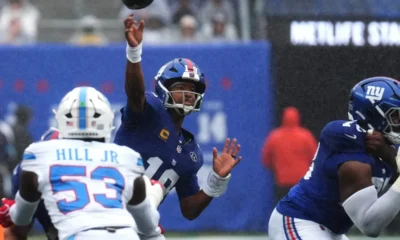
By any surface-level metric, the New York Giants’ offense hasn’t looked fluid over the past two weeks. The passing numbers are down. The rhythm has been inconsistent. And outside the building, a familiar late-season narrative has begun to form — one that frames development as regression and patience as failure.
Inside the building, Mike Kafka sees something very different.
Following the Giants’ 16–13 loss to the Minnesota Vikings, the interim head coach delivered a detailed, process-driven assessment of where the offense is — and, more importantly, why he believes rookie quarterback Jaxson Dart is still firmly on the right trajectory.
Winning the Early Downs — and Paying for the Others
Kafka didn’t shy away from the film. In fact, he opened by pointing out what did work: the run game.
“I thought our running game really took off and was a really big asset for us,” Kafka said, emphasizing how early-down success allowed the Giants to control down-and-distance for stretches of the game.
But football games are rarely decided on what works in isolation. The trouble came when New York drifted into second-and-long situations — the exact scenarios where Brian Flores’ defense thrives.
Minnesota disguised pressure, rotated coverages late, and punished hesitation with cover-zero looks and exotic blitz packages. Kafka acknowledged the offense had answers built in, but execution lagged.
“That’s something we can continue to get better at and get cleaned up,” he said — a recurring theme throughout his availability.
No Regression — Just Reality
One of the louder narratives surrounding Dart is the idea that his play has dipped since earlier in the season. Kafka flatly rejected that framing.
“I don’t see it that way,” he said. “Every game is different. How we think we’re going to win the game is different each week.”
In recent games, that path has been through the run game — nearly 30 carries per contest. Fewer dropbacks naturally lead to fewer passing numbers, but Kafka made it clear he’s not chasing box scores.
“This is an 11-man operation,” he said. “It’s not about one person’s production. It’s about finding a way to win.”
That mindset extends directly to Dart. Kafka praised his buy-in, his understanding of situational football, and his willingness to prioritize outcomes over individual stats — a rare trait in a rookie quarterback navigating constant scrutiny.
Under Center, Under Construction
One of the most revealing portions of Kafka’s comments centered on Dart’s growth under center — a departure from the shotgun-heavy background he brought with him into the league.
Rather than viewing it as a challenge, Kafka framed it as an advantage.
“He likes it,” Kafka said. “He likes how it influences the second and third levels.”
The Giants used the bye week to self-scout tendencies, identifying predictability in formation usage. From there, they began blending under-center looks, pistol sets, and play-action concepts — not to overwhelm Dart, but to expand him.
Where can he still grow? Kafka pointed to the details: eye discipline, quicker transitions after run fakes, identifying flat and hook defenders. These are not systemic flaws. They are developmental steps.
Injuries, Trust, and a Late-Game Truth
The loss to Minnesota wasn’t just a schematic challenge — it was a physical one. Multiple starters exited the game, including Andrew Thomas and John Michael Schmitz Jr. Kafka labeled the group “day-to-day” pending imaging, but the larger takeaway was philosophical.
Trust.
Even with three offensive line starters out, Kafka didn’t scale back belief — in the replacements or in Dart.
“Three minutes and 20 seconds left, two timeouts, ball at the minus-40,” Kafka said. “You’re 25 yards from a game-tying field goal, 60 yards from a game winner with the ball in Jaxson Dart’s hands. I’ll take that any day of the week.”
That statement alone cuts through weeks of outside noise.
Kayvon, the Draft, and Blocking Out the Static
Kafka also addressed the decision to place Kayvon Thibodeaux on injured reserve, emphasizing long-term health over short-term risk. It was another example of an organization choosing prudence over optics.
As for the draft chatter — the “winner-loser” framing of late-season games — Kafka dismissed it entirely.
The message inside the building is simple: correct, detail, move forward.
The focus now shifts to a matchup with the Las Vegas Raiders, but the broader evaluation remains unchanged.
Full Throttle Ahead
Kafka was asked directly whether there was any thought of sitting Dart over the final games. His answer was immediate.
“Full throttle ahead,” he said. “Jaxson’s running the ship.”
In a season defined by transition, that clarity matters. The Giants are not auditioning quarterbacks. They are building one. And while the results haven’t always followed, the foundation — trust, process, and shared accountability — is unmistakable.
Progress isn’t always linear. Sometimes it looks like restraint. Sometimes it looks like belief in moments that don’t make headlines.
And sometimes, it looks like handing the ball to your rookie quarterback with the game on the line — and meaning it.

Featured Articles





Featured Writers