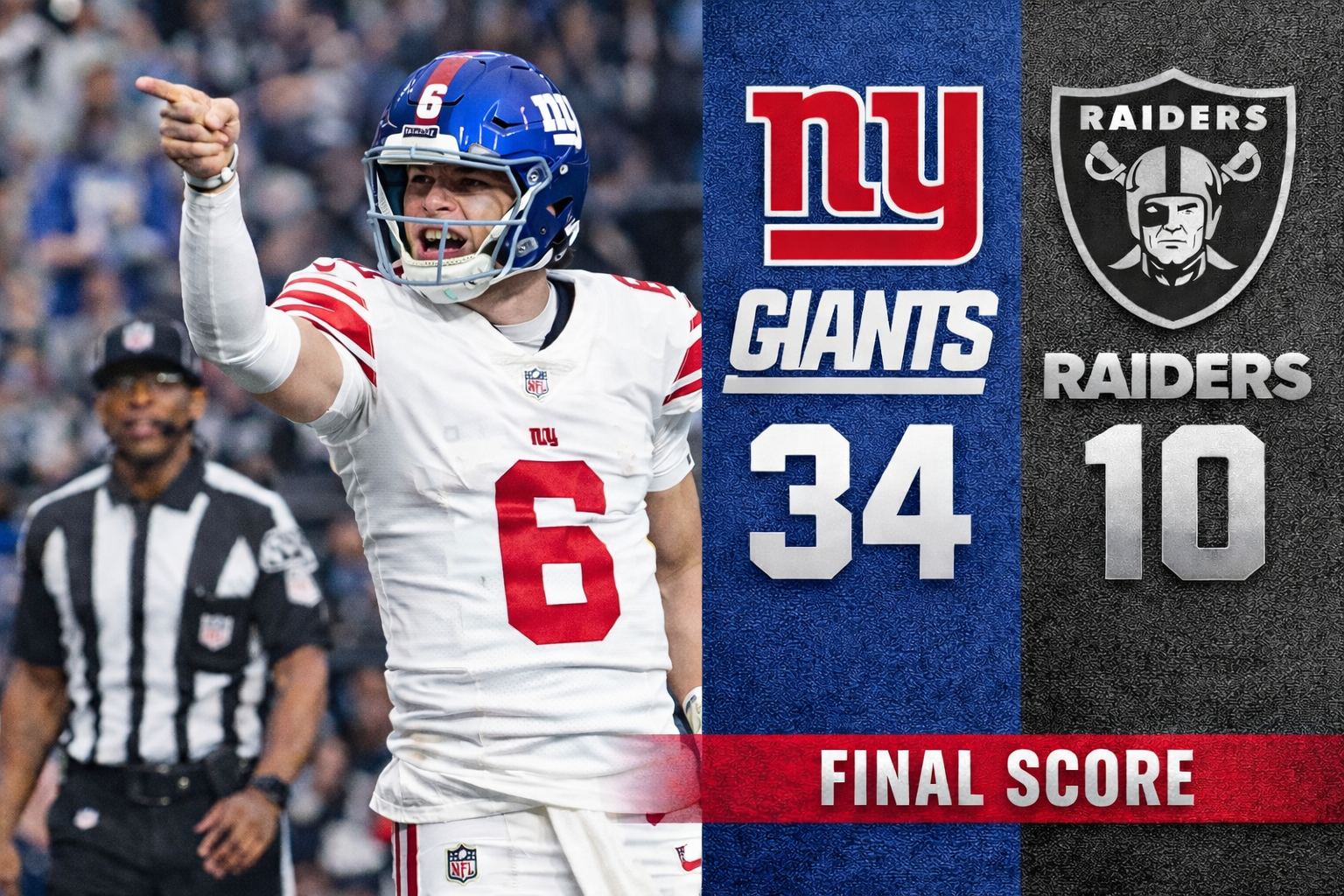
For most of the season, the New York Giants have lived inside thin margins — close losses, developmental growing pains, and the constant hum of outside speculation. Sunday in Las Vegas wasn’t about erasing all of that. It was about answering it.
The Giants’ 34–10 dismantling of the Las Vegas Raiders wasn’t dramatic or chaotic. It was controlled, composed, and deliberate — a performance that felt less like a bounce-back and more like a glimpse of clarity. Three phases. Sixty minutes. No panic.
“This league is hard,” interim head coach Mike Kafka said afterward. “Wins are hard to get. But I’m really proud of how our guys stepped up and played for each other.”
That sentiment echoed everywhere — in how the offense stayed patient, how the defense hunted in waves, and how special teams delivered the knockout punch at exactly the right moment.
Establishing control before chasing points
The Giants didn’t sprint out of the gate looking for fireworks. They opened with something better: leverage.
A short field created by Bobby Okereke’s interception return set up the first touchdown, a simple one-yard plunge that mattered far beyond the score. It established tone. It said: we’ll take what you give us and turn it into points.
That mindset carried through the rest of the first half. The Raiders briefly responded with a field goal, but the Giants never flinched. There was no sense of urgency turning into impatience. Instead, the offense stayed within structure — and that structure belonged to quarterback Jaxson Dart.
“I felt like we got into a flow early and kind of controlled the game from there,” Dart said. “We were super balanced.”
Balanced is the right word. Dart didn’t force the ball downfield. He didn’t hunt highlight throws. He trusted the reads, took yards when they were there, and punished over-aggressive looks with his legs. His first rushing touchdown was a reminder that his mobility isn’t an accessory — it’s a weapon.
Kafka saw the growth immediately.
“I’m really proud of how Jaxson rebounded,” he said. “Not only throwing the ball, but running the football as well. He controlled the game.”
By halftime, the Giants led 17–3, but more importantly, they owned the tempo. Las Vegas was reacting. New York was dictating.
Wan’Dale Robinson and the quiet violence of consistency
Some performances explode. Others accumulate. Wan’Dale Robinson’s Sunday did both.
Robinson was the connective tissue of the Giants’ offense — moving chains, winning leverage, and constantly presenting Dart with a reliable answer against zone coverage. Eleven catches. 113 yards. And with it, the first 1,000-yard receiving season of his career.
But Robinson’s day wasn’t about chasing a number. It was about reliability under pressure.
“To get it the way he did and also get the win,” Kafka said, “that’s the cherry on top for him.”
Dart was even more direct.
“That’s my guy,” he said. “I have all the confidence in the world in him. When you have that trust, you can make checks and get him the ball.”
In the first half alone, Robinson caught nine passes. It wasn’t scheme trickery — it was execution. He read coverage the same way Dart did, found windows, and turned routine completions into momentum. The Raiders knew where the ball was going. They simply couldn’t stop it.
That kind of performance doesn’t just help win games — it stabilizes young quarterbacks and anchors offenses still defining themselves.
A defense that never loosened its grip
If the offense supplied rhythm, the defense supplied inevitability.
From the opening snap, the Giants closed space quickly, tackled cleanly, and forced the Raiders into uncomfortable decisions. The run game was suffocated. Passing lanes were crowded. And when opportunities presented themselves, the Giants capitalized.
“I’m really proud of our defense,” Kafka said. “They held them in the run game and created turnovers.”
Okereke’s interception was the most visible moment, but the pressure was constant. Up front, Brian Burns played with the urgency of a finisher — collapsing pockets, hitting the quarterback, and reminding Las Vegas that no down would be easy.
Alongside him, rookie Abdul Carter continued his steady ascent. Carter didn’t just flash athleticism; he played with intent — understanding protections, attacking leverage, and contributing disruption on multiple levels.
Dart noticed it from the sideline.
“I was just watching Abdul ball,” he said. “Watching guys on defense make plays — you can feel that energy.”
That energy never dipped. Even when Las Vegas finally found the end zone late in the third quarter, the Giants’ body language didn’t change. There was no scramble. No tightening.
They knew what was coming next.
One return that erased all doubt
Momentum in the NFL is fragile — and precious. The Raiders briefly made the score 20–10, and for a heartbeat, the game asked a question.
Deonte Banks answered it.
Banks fielded the kickoff, hit daylight, and never looked back. Ninety-five yards later, the Giants had their first kickoff return touchdown since last season — and the Raiders had nothing left to reach for.
“That was a huge play,” Kafka said. “I can’t understate it. That put a stamp on the game.”
More than the score, the response mattered. Banks didn’t hesitate. He attacked the moment — and in doing so, crushed the idea of a comeback.
Finishing like a team that knows itself
There was no drama left, but the Giants didn’t coast. They finished.
Dart’s second rushing touchdown sealed the outcome, a fitting conclusion to a performance built on decision-making, patience, and trust. He didn’t try to be spectacular. He was effective.
“I felt like I was efficient,” Dart said. “I took what the defense gave me, used my legs, and stayed in rhythm.”
That rhythm defined the afternoon.
What this win really was — and wasn’t
This wasn’t about draft order. It wasn’t about silencing critics. It wasn’t about pretending one afternoon changes everything.
It was about proof.
Proof that the Giants can play connected football.
Proof that their young quarterback can command a game.
Proof that effort, structure, and belief still matter — even late in a season that has tested all three.
Kafka put it plainly.
“We were playing for each other,” he said. “That’s what this was about.”
The Giants won 34–10 on the scoreboard.
But more importantly, they left Las Vegas with something harder to quantify — clarity.
And sometimes, that’s the foundation everything else is built on.