The Baseball Hall of Fame lost several other big names in 2024 and 2025, from a legendary broadcaster to one of the most explosive players.
Baseball fans and people in the game have been morning a number of Hall of Famers in recent years. Here is part two of the series exploring the notable names lost.
Orlando Cepeda 1B/OF
(September 17, 1937-June 28, 2024, age 86)
Consistency and revolutionizing West Coast baseball, two things that largely defined the 16-year career of OF Orlando Cepeda. Joining the San Francisco Giants in 1958 (their first year in San Francisco), he made himself immediately known in the city by the bay. He slugged a home run in the first West Coast MLB game. Cepeda displayed a stellar combination of power and average hitting in his rookie season. He batted .312 with 25 home runs and a league-leading 38 doubles. This earned him unanimous Rookie of the Year honors.
In five of his next seven years with the Giants, Cepeda batted over .300 earning six All-Star selections. He was traded to the St. Louis Cardinals in 1966. The following season was career-year. In a star-studded Red Birds roster featuring several other Hall of Famers, Cepeda was the centerpiece. He hit a career-best .325 with a league-leading 111 RBIs, en-route to receiving National League MVP honors and leading the Cardinals to a World Series Championship.
Despite battling knee injuries, his career spanned 17 seasons. In nine he batted over .300, and in 12 he hit 20 or more home runs.
Rickey Henderson, OF
(December 25, 1958-December 20, 2024, age 65)
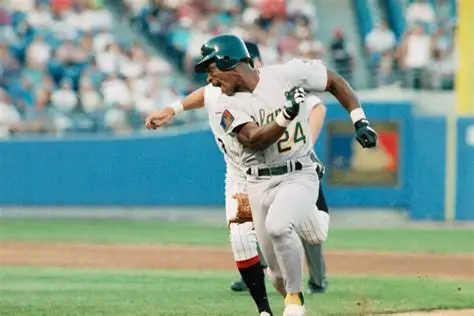
Pitchers have never and may never see a bigger nuisance of a leadoff hitter or bigger threat on the basepaths than OF Rickey Henderson.
Growing up in Oakland, California, he was a standout running back in high school. Henderson however chose to go with baseball as he signed with his hometown Oakland Athletics in 1976. In just his second season in the league, the 21-year old’s speed immediately took the basepaths by storm when he led the league with 100 stolen bases. In 1982, just his 4th season in the league, he swiped 130 bags, to break the single-season record, one that remains insurmountable to this day.
His biggest record, however, came one afternoon in 1991. In front of an Oakland crowd, he catapulted headfirst into third base to break OF Lou Brock’s all-time stolen base record of 939. 10 years later, Henderson made history yet again. As a member of the San Diego Padres, he lined a home run to left field. In crossing home plate, he became the all-time leader in runs.
His accomplishments on the basepaths don’t even begin to give a full resume of his success. An MVP, Gold Glove winner and member of the exclusive 3,000 hit club, Henderson performed in every facet of the game. No player has more leadoff home runs than Henderson’s 73, and he is one of the most memorable Hall of Famers.
Furthermore, he suited up in the green and gold in 14 different seasons and won one of his two World Series titles with them. Few players truly reached a higher level of greatness with their hometown team. Nicknamed the “Man of Steal,” he retired with 1406 stolen bases, arguably the most unbreakable record in baseball.
Bob Uecker (Broadcaster)
(January 26, 1934-January 16, 2025, age 90)
With real time calls like “Get up, get up get outta here, gone”, cinema calls like “Juuust a bit outside,” C Bob Uecker was the voice behind memorable baseball moments heard for generations. Combining lively humor with enthusiasm for big moments, he was a name synonymous with the Milwaukee Brewers franchise and baseball as a whole in Milwaukee.
Born in Milwaukee, Wisconsin, he signed with his hometown Milwaukee Braves in 1956. Uecker had a six-year MLB career playing for both the Milwaukee and Atlanta Braves, Cardinals and Philadelphia Phillies. Uecker joked about how he had a “.200 lifetime batting average in the major leagues, which tied me with another sports great averaging .200 or better for a 10-year period, Don Carter, one of our top bowlers.” Despite a brief big league career, Uecker never lost his sense of humor. This was a gateway to his legendary broadcasting career.
In 1971, Uecker became the broadcaster for the Brewers on radio and TV. Soon, he found himself in the national spotlight by joining ABC’s Monday Night Baseball in the 1970s and 1980s. Uecker was a constant all over the world of television from regularly appearing on the “Tonight Show” with Johnny Carson to starring in several Miller Lite commercials. He also found his way onto the movie screen in his role as broadcaster Harry Doyle in the 1989 classic “Major League.”
Amongst all his accomplishments on the screen, baseball was always where he was most at home from his playing days all the way till broadcasting in his final days. He called notable Brewers moments such as the team winning the pennant in 1982. His final home run call was a grand slam by young Brewers superstar OF Jackson Chourio.
In 2003, he found his way into Cooperstown and joined other Hall of Famers as the recipient of the Ford C. Frick Award (presented annually for excellence in baseball broadcasting).
Dave Parker, OF
(June 9, 1951-June 28, 2025, age 74)
Nicknamed ‘The Cobra” due to his 6-5 frame and intimidating presence on the field, Parker was one of the game’s most productive position players throughout the 1970s and 1980s.
Parker arrived in Pittsburgh in 1973. He had major shoes to fill taking over for Hall of Fame right fielder Roberto Clemente. Clemente had tragically died in a plane crash just months prior. In 1975, Parker began to make his mark both at the plate and in the field with the Pittsburgh Pirates. He slugged 25 home runs and led the league with a .541 slugging percentage. Furthermore, he led all right fielders with 315 putouts.
In 1978, he established himself among the elite with an MVP season. That season saw him lead the league with a .334 batting average and .585 slugging percentage. He also recorded a 30/20 season.
The following season, Parker made one of most sensational plays in the history of the All-Star Game. He threw a dart from right field to gun down Brian Downing at the plate. He managed to throw out two runners in that game, earning All-Star Game MVP honors. Following his All-Star Game success, he won his third straight Gold Glove and helped the Pirates to their most recent World Series championship in 1979.
After battling injuries and other issues during his later days with the Pirates, Parker got the chance to revive his career with his hometown Cincinnati Reds and revive his career he did. He made back-to-back All-Star teams in 1985 and 1986, leading the league in total bases both seasons.
Parker continued to produce late in his career. He won another World Series with the 1989 Athletics and received his seventh and final All-Star nod with the Brewers in 1990. Sadly, he died before his induction ceremony to become one of the Hall of Famers.
Ryne Sandberg, 2B
(September 18,1959-July 28, 2025, age 65)
Consistency at the second base position at Wrigley Field for over a decade may not have been on the minds of Chicago Cubs fans initially when the team traded for 2B Ryne Sandberg in 1982, but it happened.
He came over to the Cubs from the Phillies. That trade however, featured a swap of shortstops Ivan de Jesus and Larry Bowa. Sandberg, as a 20th round draft pick, was seen as a small piece in the trade.
However, Sandberg not only defied any initial expectations but became arguably the greatest to play in a Cubs uniform. In 1983 at just the age of 23, Sandberg established himself as a premiere second baseman. He led the league with 571 assists, 126 double plays turned, a .986 fielding percentage and a range factor per nine innings of 6.01. He was awarded with his first of nine consecutive Gold Gloves. During that span, he set what at the time was a record of 123 straight games without an error.
Sandberg made his presence at the plate and on the bases known in 1984. With 32 stolen bases, a league-leading 19 triples and 114 runs scored, Sandberg received National League MVP honors. That season he led the Cubs to their first playoff appearance in 39 years.
Over the next several seasons, Sandberg consistently produced at the plate. He established himself as one of the greatest hitting second basemen of all time. He set what was a record at the time with 277 home runs by a second baseman.
His contributions at the plate and in the field make him one of the most talked about Cubs players and Hall of Famers to this day.

Featured Articles





Featured Writers