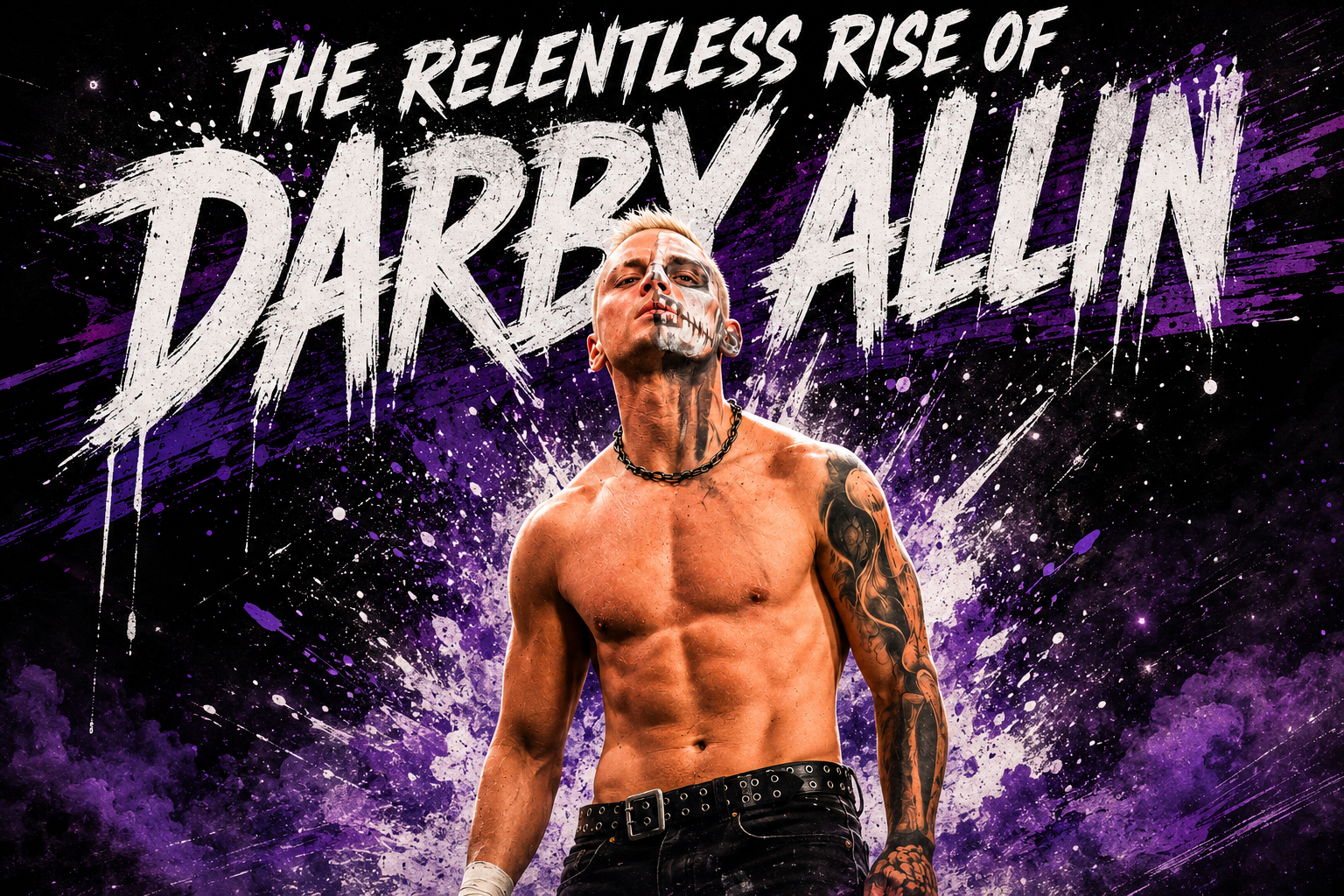
In the earliest days of All Elite Wrestling, there were stars who arrived with worldwide reputations already attached to their names. There were former world champions, independent legends, international stars, and recognizable television personalities. Then there was Darby Allin — a reckless skater with half-painted face paint, a body built for punishment, and a wrestling style that looked more like a violent car crash than a traditional wrestling match.
He didn’t look like the future face of a wrestling company.
Yet somehow, years later, that is exactly what he became.
Darby Allin’s rise to the top of AEW wasn’t manufactured in a boardroom. It wasn’t carefully polished or corporate. It happened organically because audiences saw something real in him. They saw somebody who looked like he had been fighting his entire life. Every match felt personal. Every bump felt dangerous. Every appearance felt authentic.
That authenticity became impossible to ignore.
When AEW launched in 2019, the company needed fresh stars to help separate itself from the rest of the wrestling world. It needed wrestlers that fans could identify as AEW originals. Some fans immediately gravitated toward names like MJF, Sammy Guevara, and Jungle Boy, but Darby Allin connected with audiences on a completely different emotional level.
He wasn’t trying to impress people with polished interviews or flashy catchphrases.
He was trying to survive.
That became the foundation of his character and eventually the foundation of his legacy.
The first real glimpse fans got of Darby’s potential came during Fyter Fest 2019 against Cody Rhodes. On paper, the match looked like a showcase for Cody, one of AEW’s founders and already one of the company’s major stars. Instead, it became the coming out party for Darby Allin.
The match ended in a time-limit draw, but that finish did more for Darby than a victory probably could have at the time. Fans suddenly viewed him differently. He wasn’t just an independent wrestler getting a national television opportunity. He looked like somebody who belonged on that stage permanently.
Cody later spoke glowingly about Darby’s uniqueness and emotional connection with audiences, repeatedly emphasizing that Darby represented the type of talent AEW wanted to build around. The chemistry between the two became one of the early success stories of AEW programming. Every encounter between them felt important because Darby wrestled like he had something to prove every single second he was in the ring.
That desperation became part of his appeal.
Even then, Darby spoke openly about wanting to stand out in a wrestling industry filled with performers trying to imitate each other. He once explained that he never wanted to become “just another wrestler” and wanted fans to feel something whenever they watched him compete.
Fans absolutely felt something.
Darby’s offense looked reckless. His movement looked chaotic. His willingness to destroy his own body looked frighteningly real. While many wrestlers spend years learning how to make danger look safe, Darby often looked like he was erasing the line between performance and actual harm.
That’s what made people emotionally invest in him.
Over time, AEW officially branded Darby as one of the company’s “Four Pillars” alongside MJF, Sammy Guevara, and Jungle Boy Jack Perry. While the other stars developed and evolved in different ways, Darby somehow stayed exactly who he was from the beginning — and that consistency mattered.
MJF became more polished and manipulative.
Jack Perry evolved into a darker personality.
Sammy Guevara leaned further into athletic showmanship.
Darby remained the damaged underdog who refused to quit.
That authenticity made him special.
Fans didn’t rally behind Darby because he dominated opponents. They rallied behind him because he kept getting back up. There was something relatable about somebody constantly being physically overmatched but mentally refusing to surrender.
That mentality helped define his TNT Championship reigns.
Before Darby ever became AEW World Champion, he established himself as one of the company’s most dependable stars through the TNT Championship. His matches carried urgency. Darby wrestled television main events like they were career-defining moments. Nothing ever felt phoned in. Every Coffin Drop looked painful. Every dive looked terrifying. Every match felt like it could spiral out of control at any moment.
Darby once explained his mentality by saying, “You have to wrestle every match like it’s your last match because tomorrow is never promised.”
That quote perfectly captures why fans connected with him.
There was no complacency in his performances.
Everything mattered.
Tony Khan noticed that commitment immediately. Over the years, Khan repeatedly praised Darby for his willingness to sacrifice himself for the company and for constantly delivering in high-pressure situations. Khan once described Darby as “the heart and soul of AEW,” while also praising his fearlessness and creativity.
What made Darby different from many wrestlers was that his dangerous personality extended beyond the ring.
He didn’t simply perform risk.
He lived it.
The skateboarding stunts.
The body bags.
The insane dives.
The fire spots.
The willingness to get thrown down stairs or crash through glass.
Darby built a reputation as somebody who genuinely embraced danger instead of simply portraying it.
Then came the relationship that changed his career forever: Sting.
When Sting debuted in AEW, fans wondered which younger wrestler would become associated with one of the most iconic performers in wrestling history. The answer turned out to be perfect.
Darby Allin and Sting didn’t feel like a forced mentor-student pairing created for television.
It felt real.
Sting saw something in Darby that reminded him of himself during his early WCW days — the mysterious outsider who connected emotionally with audiences without needing to overexplain himself.
The partnership elevated Darby to another level.
Together, they became one of the most beloved acts in AEW. Their cinematic street fights, chaotic tag team matches, and emotional moments created some of the company’s most memorable television. More importantly, Sting’s trust in Darby validated him in the eyes of older wrestling fans who may not have initially understood him.
Sting once called Darby “fearless” and admitted there were moments where even he became concerned watching some of Darby’s stunts unfold.
That says a lot considering Sting’s own legendary career.
Darby also openly discussed how much the relationship meant to him personally. He spoke about wanting to honor Sting’s legacy and making sure every moment they shared together felt meaningful. Their bond eventually became one of the emotional centerpieces of AEW programming.
When Sting retired under the AEW banner, Darby became part of wrestling history alongside him.
That mattered.
It elevated Darby from rising star into cornerstone talent.
Yet even as his star grew, Darby kept searching for bigger challenges outside wrestling. That eventually led to one of the most surreal moments of his career — climbing Mount Everest and planting an AEW flag at the summit.
At first, many fans viewed the idea as another outrageous Darby Allin stunt.
Then he actually did it.
Darby later reflected on the experience and admitted it changed him emotionally and mentally. He spoke about witnessing death on the mountain and how the experience humbled him. In one interview, Darby admitted, “My ego died on that mountain.”
That quote revealed something deeper about him.
Darby Allin was never driven by ego.
He was driven by purpose.
He also proudly spoke about planting the AEW flag atop Everest, saying, “No wrestler’s ever done that before.”
That moment became symbolic of Darby’s entire AEW journey.
He constantly chased things nobody else would even attempt.
While many wrestlers focused on becoming celebrities or building brands, Darby focused on creating unforgettable moments. That mindset made him feel less like a traditional wrestler and more like an artist willing to destroy himself for his craft.
As AEW evolved through injuries, backstage controversies, roster changes, and shifting creative directions, Darby remained one of the company’s most trusted and beloved figures. Other stars came and went. Some retired. Some moved elsewhere. Darby stayed.
That loyalty became important.
Fans viewed him as one of AEW’s true originals.
Tony Khan consistently emphasized Darby’s importance to the company. When discussing Darby’s eventual rise to the AEW World Championship, Khan explained, “Darby Allin is red hot. He’s somebody that the fans truly believe in.”
That belief had been building for years.
Darby’s world championship victory didn’t feel manufactured or rushed. It felt earned because fans had witnessed the entire journey in real time. They watched him nearly destroy his body for years. They watched him evolve beside Sting. They watched him carry the TNT Championship. They watched him represent AEW on one of the biggest mountains in the world.
Then they watched him finally become AEW World Champion.
Tony Khan later called Darby “a very special champion” and praised him as “a great representative for AEW and professional wrestling.”
The title victory wasn’t simply about Darby winning a championship.
It was about AEW rewarding loyalty, authenticity, and sacrifice.
Darby himself approached the championship differently than most wrestlers probably would have. Before his Everest climb, Darby reportedly told Tony Khan, “I already feel like I’m the champion of the world.”
That quote perfectly summarizes who Darby Allin is.
The championship didn’t define him.
The audience already viewed him as special long before he held the title.
Winning the championship simply completed the story.
What makes Darby’s journey so compelling is that he never looked or sounded like somebody chasing mainstream acceptance. He never felt corporate. He never felt overly scripted. He felt like a real person carrying emotional scars into every performance.
That authenticity made fans trust him.
And in modern wrestling, trust matters more than almost anything else.
Darby also represents something incredibly important for AEW historically: a true homegrown success story.
Yes, AEW has signed major established stars over the years. Yes, the company has benefited from huge names arriving from other promotions. But Darby became famous because of AEW, and AEW became stronger because of Darby.
Their stories are connected forever.
There is also something poetic about the fact that one of wrestling’s most dangerous performers became one of the company’s emotional anchors. Darby matches always feel unpredictable because there’s always a sense that something unbelievable might happen.
Sometimes that unpredictability creates magic.
Sometimes it creates concern.
But it always creates emotion.
Even now, fans continue wondering how long Darby can maintain such a punishing style. Every horrifying dive shortens the clock a little bit more. Every reckless stunt feels dangerous. Every match feels physically taxing.
Yet that danger is also part of what makes Darby so compelling.
He reminds audiences that wrestling is supposed to feel risky.
Supposed to feel emotional.
Supposed to feel real.
From the moment he wrestled Cody Rhodes to a draw in 2019, Darby Allin felt connected to AEW’s future. Years later, he now stands at the center of its present as AEW World Champion.
The road wasn’t polished.
It wasn’t conventional.
It wasn’t safe.
It was Darby Allin crashing his body into walls, diving off ladders, surviving brutal wars, carrying Sting’s legacy, climbing Mount Everest, planting the AEW flag at the top of the world, and refusing to disappear no matter how much punishment he absorbed.
That’s why fans embraced him.
Because underneath the face paint and chaos was somebody audiences genuinely believed in.
And in the end, that belief turned a reckless outsider into the face of AEW.

Featured Articles
-

Features
/ 1 day agoWhy Ben Rice Should Be the AL MVP
Ben Rice has emerged as one of the American League’s most valuable players in...
-

Community Events
/ 6 days agoMore Than a Wrestling Show: Steve Maclin and Deonna Purrazzo Turned an Idea Into Battle for the Brave
The sound of bagpipes echoed throughout the Rahway Recreation Center as fans slowly rose...
By Randy Zellea -

Big Blue Report
/ 1 week agoGiants Announce 2026 Training Camp Schedule at The Greenbrier
The New York Giants are taking training camp on the road in 2026, and...
By Randy Zellea -
Wrestling
/ 1 week agoTNA Can Get Back On Track In Two Easy Steps
Let’s be 100% honest for a second: TNA is in a bad spot right...