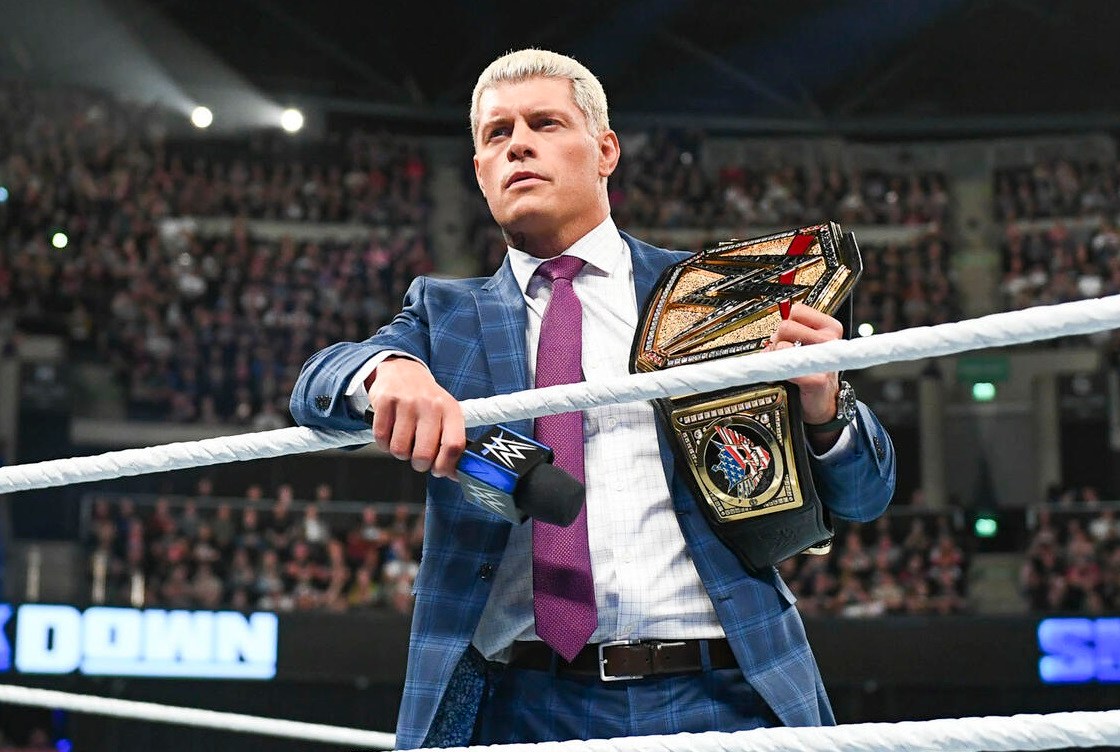
Let me get something out of the way before anyone reads this and assumes I’m taking a shot at Cody Rhodes.
I like Cody. I respect Cody. I respect what he has accomplished in this business, from his first run in WWE, to leaving the company and reinventing himself, to becoming one of the people who helped build AEW, and ultimately returning to WWE and finishing the story he had been trying to finish for years.
That doesn’t mean I think everything Cody does is great.
Nobody hits a home run every time they get the ball. Sometimes you hit a double. Sometimes you get a single. Sometimes you strike out. That’s sports, and that’s professional wrestling.
What I do think is worth discussing is whether WWE has reached a point where it needs to make some changes to the Cody Rhodes character.
Because if you look at the reaction Cody is getting from portions of the WWE audience, there is a real conversation taking place.
Cody Rhodes is at a crossroads.
And considering his finishing move is the Cross Rhodes, maybe that’s the perfect place for him to be.
The Chase Was Better
The biggest question I have about Cody’s WWE run isn’t whether he has been a good champion. He has.
It’s whether the story after he won the championship ever matched the story that got him there.
The chase was fantastic.
Cody left WWE and rebuilt himself. He became a major star in Ring of Honor and then one of the central figures in the creation of AEW. He eventually became one of AEW’s executive vice presidents, while also becoming one of the company’s biggest stars.
Then things changed.
Cody and the AEW audience began to drift apart, and his decision not to turn heel became part of the discussion surrounding him.
In 2019, Cody put himself in a very interesting position before his AEW World Championship match with Chris Jericho at Full Gear. Because he was both an executive and a challenger for the company’s top championship, Cody said that if he lost, he would never challenge for the AEW World Championship again.
He lost.
And he kept his word.
Cody explained that the decision was about avoiding the perception that his position in management had anything to do with his opportunities in the ring. He also connected the issue to the criticism his father, Dusty Rhodes, had faced during his own career.
That decision ultimately became one of the things that helped push Cody into a creative corner in AEW.
Then he left.
He returned to WWE.
He had the incredible feud with Seth Rollins.
He suffered the torn pectoral injury.
He came back.
He won the Royal Rumble.
He went after Roman Reigns.
He lost at WrestleMania 39.
Then, one year later, Cody Rhodes defeated Roman Reigns at WrestleMania 40 and finally finished the story.
That was the payoff.
And what a payoff it was.
The problem is that professional wrestling doesn’t end when you finish the story.
You have to figure out what the next story is.
That’s the Part That Hasn’t Worked as Well
This is where I think the Cody conversation gets interesting.
I’m not saying Cody has had bad matches.
He hasn’t.
I’m not saying he hasn’t had memorable moments.
He has.
But when I think about some of the great championship runs in wrestling history, the champion became the reason I wanted to watch the show.
With Roman Reigns, you wanted to know who was finally going to beat him.
With Stone Cold Steve Austin, you wanted to know what he was going to do next.
With Hulk Hogan, people wanted to see whether anybody could finally knock him off.
With Cody, there have been plenty of good matches, but I don’t know if the championship has consistently created that same feeling of, “I have to watch this because I need to see what happens to Cody.”
That’s an important distinction.
And Cody actually addressed this issue with Chris Van Vliet back in 2024.
When asked about turning heel, Cody talked about WWE being bigger than any individual performer.
“It’s great to have a quarterback, great to have franchise players or top stars, whatever it might be, but it’s going to move on with or without you there, someone will fill that spot.”
That’s Cody talking about the role of a top star, and I think the quarterback comparison is perfect for what we’re discussing now.
Cody is QB1.
But sometimes QB1 needs a different game plan.
We’ve Seen This Before
There are plenty of examples in wrestling where the chase was more memorable than the championship reign that followed.
Daniel Bryan at WrestleMania 30 immediately comes to mind.
The chase was extraordinary. The crowd was emotionally invested in seeing Bryan overcome the odds and finally win the WWE Championship.
The victory was one of the great WrestleMania moments.
But once he became champion, the story didn’t have the same momentum.
Sting’s chase of Ric Flair in 1990 is another example. The build to their Clash of the Champions match created enormous anticipation, and Sting eventually became champion, but the championship run itself never reached the level of excitement surrounding the chase.
Dolph Ziggler’s Money in the Bank cash-in in 2013 created one of the biggest reactions of his career. The audience had been waiting for that moment, and when it finally happened, the building exploded.
But the actual championship reign was incredibly short.
Jey Uso is a more recent example of something slightly different. His rise created an incredible connection between the wrestler and the audience. The “YEET” phenomenon became bigger than the championship itself. Fans wanted to participate in the Jey Uso experience.
That’s an important lesson.
Sometimes people aren’t paying to see the championship.
They’re paying to see the person holding it.
And that’s where I think WWE needs to figure out what Cody’s next chapter is.
The Bret Hart Comparison
The comparison I keep coming back to is Bret Hart.
I’m not saying Cody Rhodes is Bret Hart.
They’re different performers with different personalities, different styles and different careers.
But Bret provides an interesting example of what can happen when a performer becomes so committed to being the good guy that the audience starts wanting something different.
Bret was one of the most respected performers in wrestling. He was a great wrestler, a believable champion and an excellent storyteller.
Then Steve Austin came along.
Austin constantly pushed Bret’s buttons. Bret became frustrated. He began looking increasingly bitter and resentful, and eventually the audience started looking at Bret differently.
That transformation helped create one of the greatest rivalries in wrestling history.
The lesson isn’t that Cody needs to copy Bret Hart.
The lesson is that sometimes the audience doesn’t need the same version of a character forever.
Maybe the audience needs to see the character challenged.
Maybe the character needs to change.
Cody Has Already Been Here Once
That’s why the AEW history matters.
Cody has already experienced what happens when an audience starts looking at him differently.
The interesting part is that Cody never really wanted to embrace the full heel turn.
In his 2024 interview with Van Vliet, Cody discussed the Homelander comparisons that came from his AEW run and acknowledged that there may have been something to the idea that he was presenting himself as a good guy while the audience was beginning to see something else.
He said:
“I think the AEW run where people thought I’m pretending to be a good guy but I’m actually a bad guy, which maybe it was what was happening?”
That’s a fascinating admission.
Because maybe that’s what is happening again.
Cody isn’t necessarily doing anything wrong.
Maybe the audience has simply reached the point where they’ve seen enough of the same Cody Rhodes.
And Cody himself acknowledged earlier this year that something has changed.
Speaking with Van Vliet in March, Cody said:
“I was never a polarizing wrestler. Now I’m a polarizing wrestler.”
That’s significant because Cody isn’t pretending the reaction doesn’t exist. He said he was honored by the passion coming from both sides of the audience and wanted to make sure it didn’t get to him.
So maybe the question isn’t whether WWE should panic about the reaction.
Maybe the question is whether WWE should use it.
What Happens If Cody Changes?
This is where I think things get really interesting.
I don’t necessarily want to see Cody become a cartoon villain.
I don’t need him to start cheating every week or cutting promos about how much he hates the fans.
I think something much more subtle could work.
What if Cody simply becomes more confident?
What if he becomes a little more selfish?
What if the man who spent years trying to prove he belonged finally decides that he doesn’t need anybody’s approval anymore?
That could change everything.
Cody has spent years being the guy who does the right thing. He talks about his family. He talks about his father’s legacy. He talks about the fans. He talks about finishing the story.
Maybe it’s time for him to become the guy who believes the story is finished and everyone else needs to catch up.
That would also make Randy Orton an extremely interesting opponent.
Orton has been everything in WWE. He’s been the villain, the babyface, the Legend Killer and the veteran who knows exactly how to manipulate an opponent.
Cody is now the establishment.
He’s the American Nightmare.
He’s the son of Dusty Rhodes.
He’s the guy who finished the story.
What happens if those roles start to reverse?
What happens if Orton becomes the guy the audience trusts while Cody becomes the guy they want to see get knocked down?
That could be a very different Cody Rhodes.
And it could be exactly what the character needs.
WWE Has to Listen, But It Also Has to Be Smart
There’s an important distinction here.
WWE shouldn’t change Cody’s character because a few people on social media are complaining.
Bruce Prichard has talked about the danger of relying too heavily on social media reactions and the importance of listening to the people who actually consume and pay for the product.
That’s the difficult part of wrestling.
You have to figure out whether the reaction you’re hearing represents an actual shift in the audience or simply the loudest people online.
But if the live crowds continue showing signs that they want something different from Cody, WWE has to at least consider it.
And Cody has already shown that he’s capable of changing.
This is a guy who went from Cody Rhodes to Stardust, left WWE, reinvented himself, helped create AEW, became an executive, became a top star, left AEW and returned to WWE as the American Nightmare.
He’s not incapable of reinvention.
He’s done it before.
So, Is It Time to Bench QB1?
That’s the question I’m asking.
Not because Cody Rhodes has failed.
He hasn’t.
Not because I don’t like him.
I do.
And certainly not because I think WWE should suddenly throw away everything that made Cody successful.
I think WWE has to recognize that the audience may be ready for something different.
Maybe Cody doesn’t need to be benched.
Maybe he just needs to come out of the huddle with a different play.
The chase made Cody Rhodes a bigger star.
Finishing the story made him a champion.
Now WWE has to figure out what makes Cody Rhodes must-see again.
Because that’s the difference between being a great part of the show and being the reason people tune in.
Cody has already proven he can carry the ball.
He’s already proven he can be QB1.
Now the question is whether WWE is willing to let him change the way he plays the game.
Maybe the next chapter isn’t about Cody proving that he’s the good guy.
Maybe it’s about finding out what happens when Cody Rhodes stops caring whether everybody thinks he is.

Featured Articles





Featured Writers