
Late on June 14, hockey fans everywhere watched as the core of the Stanley Cup champion Carolina Hurricanes Sebastian Aho, handed off sports most sought after trophy to fellow alternate captain Jaccob Slavin.
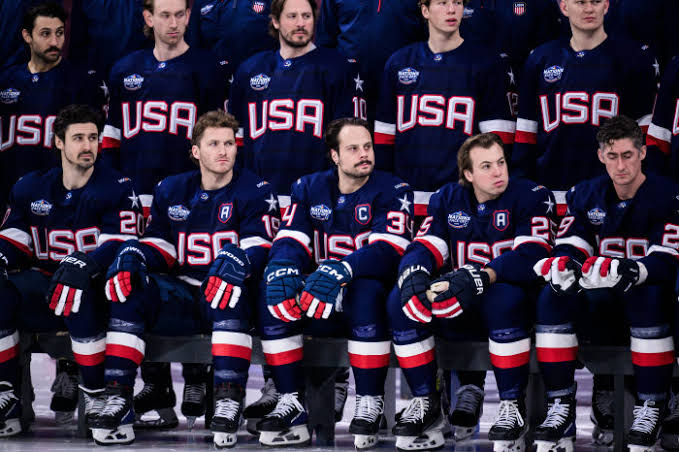
This was Slavin’s second time this year alone reaching the pinnacle of hockey. Earlier this year, Slavin was a member of the U.S. Olympic men’s ice hockey gold medal winning team. They were the first to accomplish the feat since the historic 1980 Miracle on Ice team.
The 32-year-old defenseman joined elite company. He became just the second US-based player to hoist a Stanley Cup and wear Olympic gold in the same year. The first was Ken Morrow. Morrow was part of the aforementioned 1980 team before winning the cup with the New York Islanders.
Slavin’s story is the ultimate ending to the many big stories that coincided with USA Hockey gold, and this year’s Stanley Cup Playoffs. Other stories have also recently arisen around offseason moves. These stories should leave fans optimistic about the continual rise of hockey in the US, even beyond the NHL.
Gold Medalists Taste Success in the Playoffs
Stanley Cup Finals Representation
Slavin contributed on key defensive pairings throughout various competitions. During the Olympics, he was on the second defensive pairing with Brock Faber. There, he went up against some of the toughest competition. Slavin helped kill off a key late power play in regulation of the gold medal game. In the clinching game 6 of the finals, he created a turnover to set up Taylor Hall, in what ended up being the game-winner for the Hurricanes. Several other big tests came for him throughout the playoffs. He went head-to-head with Olympic teammate Jack Eichel.
Eichel himself had a season to remember as the core centerman of the Vegas Golden Knights. The team made a memorable, unexpected run to the Stanley Cup Final. He led the team with 90 points in the regular season, dished out several key assists throughout the playoffs and had a key goal to tie game 2 in the 3rd period of the Western Conference Final, all while playing major minutes.
Representation Throughout the Playoffs
The Minnesota Wild themselves had a memorable playoff run. Three of their biggest contributors were gold medalists. They won a hard-fought playoff battle in six games against a stacked Dallas Stars team, their first playoff series win in 11 years. Superstar defenseman Quinn Hughes (who scored the overtime game-winner against Sweden in the quarterfinals) took the Wild’s attack from great to spectacular. After being acquired via trade in December of this past season, Hughes was instrumental in every way in the playoffs. He tied for the team lead tallying 15 points in 11 games, while leading the team with an average ice time of 30:57 per game. Second to Hughes in time on ice was the aforementioned Faber.
A key piece of the Wild’s offensive attack came from forward Matt Boldy. After scoring a highlight-reel goal in the gold medal game, Boldy did not slow down. He finished the season with a career-high 42 goals and 85 points. His elite puck handling skills were continually on display throughout the playoffs. He led the Wild with seven goals in the playoffs. This included a key overtime game-winning tip-in goal to tie the series at two games apiece.
Centerman Tage Thompson awoke the city of Buffalo, New York. He scored the first two goals in the Buffalo Sabres first playoff game in 15 years. The team went on a memorable run to the second round. Thompson led them with 15 points in 13 games.
USA gold was well represented across the league. 16 players from the roster were on playoff teams, the most of any country.
USA Hockey Family
Amongst the many storylines, what made this gold medal team extra special was how tight-knit the group was. From several of the players developing together in youth hockey, to the many family ties on the team, their chemistry was one for the ages.
Hughes and Tkachuk’s Heroics
Both Hughes brothers had game-winning goals for the history books. Just days after the aforementioned Quinn Hughes won it against Sweden, Jack Hughes scored the famous golden goal against Canada. The Hughes family legacy however, stretches beyond the brothers. Their mother, Ellen Weinberg-Hughes, was a former USA hockey player herself. This Olympics, she served as a player development consultant for the gold medal winning USA women’s hockey team. Furthermore, the head coach of the women’s team John Wroblewski had previously coached the Hughes brothers with the development program.
Speaking of development, Quinn Hughes not only played, but he lived with forward Brady Tkachuk and his dad Keith Tkachuk during his teenage years. This happened while playing with the development program. Brady, along with his brother Matthew Tkachuk continued to carry on their dad’s legacy of grit and hard play on the ice.
This upcoming season, both Tkachuk brothers will join forces on the same NHL roster for the first time in their careers. On June 23, it was announced that Brady was traded to the Florida Panthers to join his brother. Moments after, it was announced that Keith Tkachuk was inducted into the Hockey Hall of Fame.
The Hughes and Tkachuk brothers all were part of the very heartbeat of the team, while the families are a major part of the very fabric of USA hockey as a whole.
The Nelson and Gadreau Legacies
Another family just as synonymous with USA Hockey gold, is that of forward Brock Nelson. No Olympic gold by USA men’s hockey has ever been won without a member of Nelson’s family. His uncle Dave Christian won gold with the 1980 team, while both his grandfather Bill Christian and great uncle Roger Christian were part of the 1960 gold medal-winning team.
The team also made sure the late great Johnny Gaudreau was present in the celebration. They held his jersey in the gold medal team photo and invited his young kids into the photo.
Will the USA hockey family continue to develop new superstar legacies?
Future Outlook for USA Hockey
As fans across the country have also enjoyed the rise of soccer in the US thanks to their success in the World Cup, this NHL season may be looked at as a significant turning point for the rise in hockey in years to come.
This rise was evident in the 2026 playoffs, which averaged 1.8 million viewers across the country, setting a record. Furthermore, the US became the first nation in the history of the Winter Olympics to claim triple gold in hockey, also doing so with their women’s and Paralympic Sled Hockey teams taking the top prize.
Another factor, is the continual rise in attention towards college hockey, an important step in the development of several American-born players. This year’s Frozen 4 National Championship game was the most watched championship game on ESPN since 2009.
Shortly after the Stanley Cup Playoffs, the NHL held their draft. In the 2026 draft, 53 Americans were taken overall (one more than in 2025), including five in the first round. Additionally, news around trade rumors and contract extensions across the league have centered around some of the members of the gold medal team. The Professional Women’s Hockey League also had their draft. The first five players selected were American. This included first overall pick and the core of the US women’s gold medal winners Caroline Harvey.
The world of hockey can expect US talent to continue to contribute big moving forward.

Featured Articles







Featured Writers


