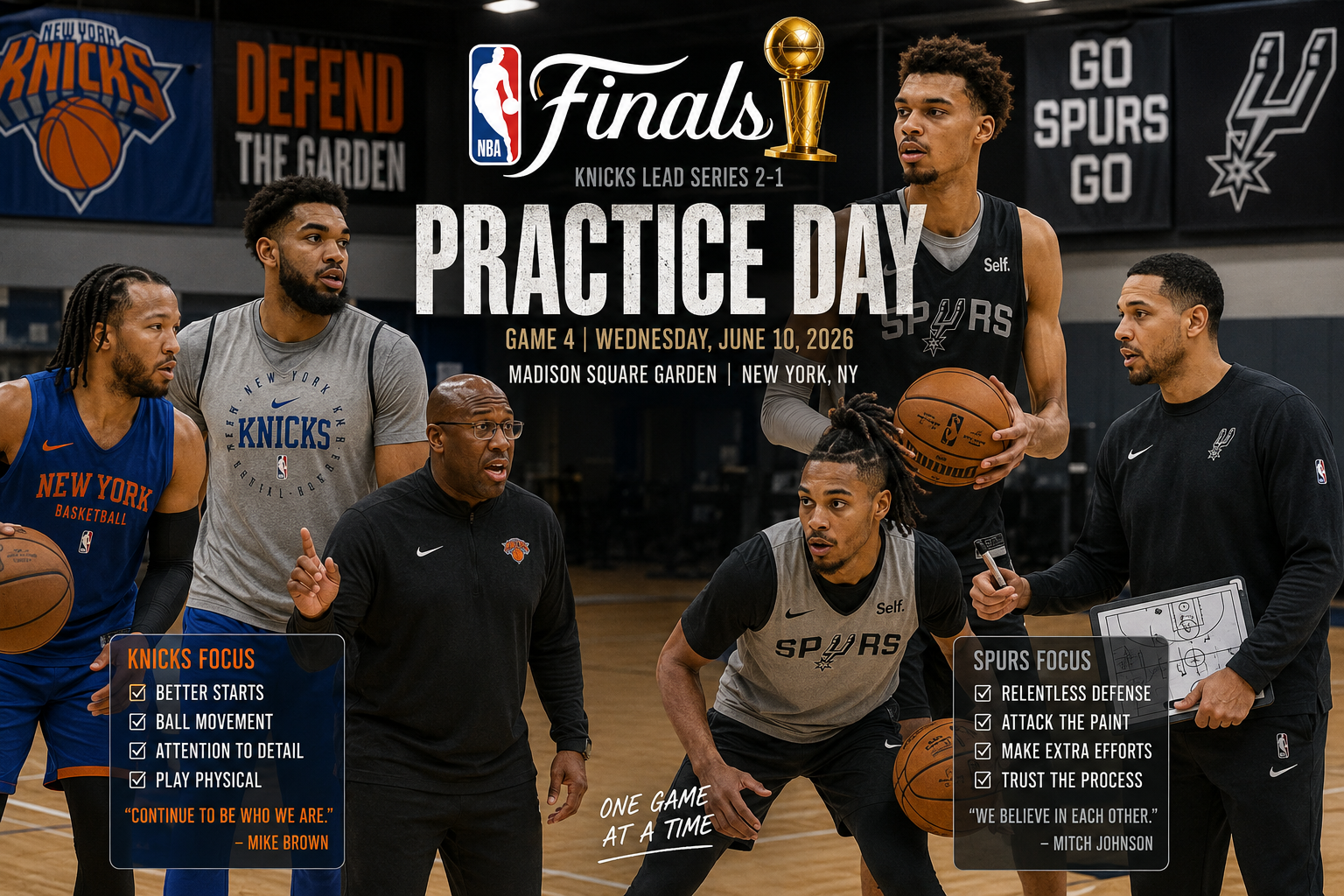
The tension of the NBA Finals was present Tuesday, but panic was nowhere to be found.
One day after the San Antonio Spurs stunned Madison Square Garden with a critical Game 3 victory, both teams returned to work with remarkably similar messages: stay disciplined, trust the process, and remember what got them here.
With the New York Knicks still holding a 2-1 series lead and Game 4 looming, the conversations inside both locker rooms centered less on pressure and more on execution.
For the Spurs, confidence continues to flow from their young superstar. For the Knicks, belief remains rooted in a team that won 13 straight games before Monday night’s setback.
Wembanyama Embracing the Moment
Victor Wembanyama has spent much of these Finals proving that the stage is not too big for him.
After his dominant performance in Game 3, the 7-foot-5 phenomenon spoke about the growth he’s experienced throughout his playoff journey and why he believes success doesn’t always require years of postseason heartbreak.
Asked whether a player can learn quickly enough during a playoff run to avoid the traditional cycle of failure before success, Wembanyama didn’t hesitate.
“We will see,” he said. “But my bet would be yes, it’s possible.”
The confidence isn’t arrogance. It’s conviction.
Throughout the playoffs, Wembanyama has steadily evolved as defenses continue throwing different coverages, bodies and schemes at him. What once looked like instinctive shot-taking has become calculated decision-making.
“I think I got much, much better at it,” Wembanyama said. “Sometimes I was just shooting shots. Even still to this day. Sometimes it goes in. But the efficiency, the purposefulness is so much better now.”
That development was on full display in Game 3.
Rather than settling for perimeter jumpers, Wembanyama consistently attacked the paint and put pressure on New York’s defense.
“The goal is always to go inside,” he explained. “The best shot in the game is an alley-oop. The most efficient shot.”
His approach reflects a player whose understanding of the game is catching up to his unprecedented physical gifts.
Perhaps the most revealing answer came when Wembanyama was asked about developing young players.
His advice?
“Play on your weaknesses, not only your strengths.”
It’s a philosophy that has clearly shaped his own growth and one that has transformed him from a uniquely talented prospect into arguably the most impactful player remaining in the Finals.
Mitch Johnson Sees Growth Beyond the Numbers
Spurs head coach Mitch Johnson believes the growth of his franchise cornerstone extends far beyond statistics.
Johnson described Wembanyama’s development as a process of pattern recognition—something all great players eventually master.
“A player of his caliber sees so many coverages, groupings, matchups,” Johnson said. “Over time there just becomes a comfortability, familiarity, and then confidence.”
Johnson compared the process to the evolution experienced by the game’s all-time greats.
As players accumulate experience, they move beyond simply recognizing what defenses are doing. Eventually they begin manipulating those defenses.
“I think he’s just on that same pathway,” Johnson said.
The coach’s confidence extends beyond Wembanyama.
Despite being one of the youngest teams in the league, San Antonio has consistently responded to adversity throughout the season.
After losing Games 1 and 2, many expected the Spurs to crack under the pressure of their first Finals appearance. Instead, they delivered one of their most complete performances of the postseason.
“We believe in what we put into this deal and each other,” Johnson said. “That’s been through adversity and success throughout the season.”
For Johnson, belief isn’t about age or experience.
“It’s a makeup and personality thing.”
Castle’s Maturity Continues to Shine
Rookie sensation Stephon Castle sounded far more like a seasoned veteran than a first-year player preparing for Game 4 of the NBA Finals.
Castle credited the Spurs’ resilience to their ability to learn from defeat.
“We haven’t lost three games in a row all year,” Castle said. “Just us being able to take a loss, look at it and see what we could do better from it and apply it right away.”
The rookie also offered insight into what allows San Antonio to thrive in hostile road environments.
“I feel like that’s when we play at our best,” Castle said of crowds like Madison Square Garden.
Castle emphasized that San Antonio’s defensive improvement in Game 3 wasn’t necessarily about strategic adjustments.
It was about effort.
“We emphasized that last night,” Castle said. “I thought our rotations were great.”
That commitment to making one extra rotation, one extra closeout, and one extra hustle play became the difference in a game decided by fine margins.
Knicks Focused on Fundamentals
While the Spurs celebrated a breakthrough victory, the Knicks spent practice day looking inward.
The message from head coach Mike Brown, Jalen Brunson and Karl-Anthony Towns was remarkably consistent.
Ball movement.
Attention to detail.
Physicality.
Those three themes surfaced repeatedly throughout Tuesday’s media sessions.
Brown was particularly frustrated by New York’s offensive execution in Game 3.
“It’s been pace, it’s been space, it’s been getting the ball reversed, it’s been touching the paint, and more importantly it’s been making quick decisions,” Brown said.
According to Brown, too many possessions stalled because players held onto the basketball instead of making immediate reads.
“There were a lot of times where the decisions weren’t made quick.”
Brunson echoed that sentiment.
“Not turn the ball over,” the Knicks captain said when asked what needed improvement. “Continue to be who we are.”
The Knicks have built their Finals run on connectivity, pace and trust. In Game 3, those elements disappeared for stretches.
The result was their first loss in more than six weeks.
Yet nobody inside the organization appears shaken.
“We have a veteran group,” Brown said. “Nobody is panicking.”
Towns Looking to Solve the Puzzle
Few players face more defensive variety than Karl-Anthony Towns.
The Spurs have thrown multiple defenders at him throughout the series, constantly changing matchups and coverages.
For Towns, the challenge is familiar.
“Whenever the defense presents itself to me, I just want to solve that puzzle,” he said.
Towns acknowledged that New York has repeatedly put itself in difficult positions with slow starts.
The Knicks have trailed early in all three Finals games, forcing them to spend valuable energy fighting back.
“The Spurs have done a great job starting the game, dictating the pace and dictating how the game is going,” Towns said. “We have to try to be the first ones to throw the first punch.”
More than anything, Towns believes the solution lies in returning to the habits that fueled New York’s 13-game winning streak.
“We’ve got 50 days of film to show what it looks like when we’re at our best,” Towns said.
The answer isn’t reinventing anything.
It’s rediscovering what already works.
A Shared Message Before Game 4
Perhaps the most fascinating takeaway from practice day was how similar both teams sounded despite being on opposite sides of the series.
San Antonio believes it belongs.
New York believes one loss changes nothing.
The Spurs are talking about growth, belief and learning.
The Knicks are talking about discipline, execution and fundamentals.
Neither side appears rattled.
Neither side appears overwhelmed by the moment.
As Game 4 approaches, the Finals may ultimately come down to which team best follows its own message.
The Spurs believe their relentless confidence can carry them back to even terms.
The Knicks believe their identity can carry them two wins away from a championship.
Wednesday night will reveal which belief system proves stronger.
For now, both locker rooms remain convinced that the best basketball of the series is still ahead.

Featured Articles




Featured Writers