The latest wave of releases from WWE is not just another roster update to scroll past and move on from. It is a defining moment, one that signals a clear philosophical shift in how the company views its talent, its storytelling, and ultimately, its identity. This is not about trimming the bottom of the roster or making room for incoming prospects. This is about restructuring what WWE wants to be moving forward.
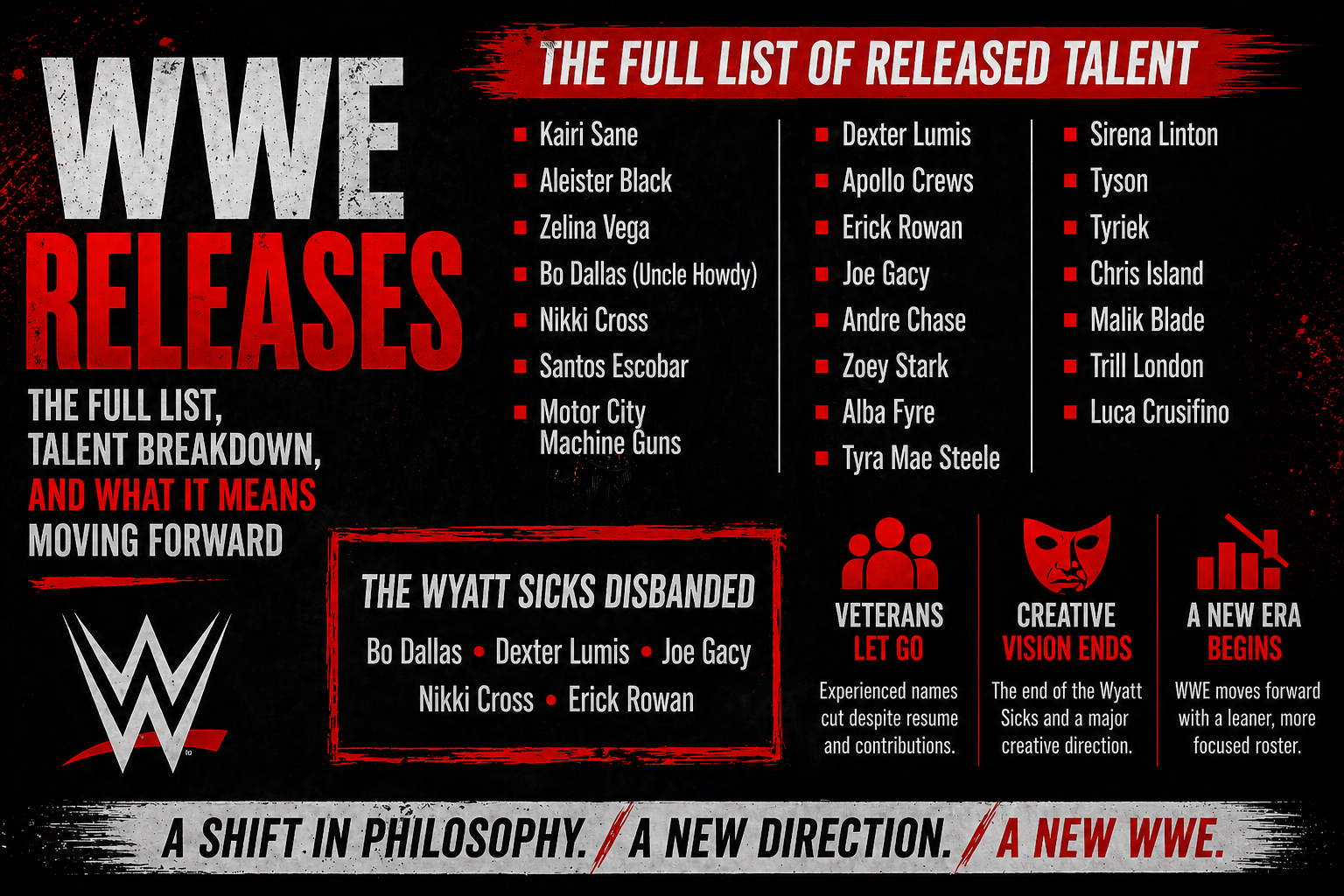
The list itself is extensive and telling. Among those released are Kairi Sane, Aleister Black, Zelina Vega, Bo Dallas, Nikki Cross, Santos Escobar, the Motor City Machine Guns, Dexter Lumis, Apollo Crews, Erick Rowan, Joe Gacy, Andre Chase, Zoey Stark, Alba Fyre, Tyra Mae Steele, along with a number of developing talents including Malik Blade and Luca Crusifino. On paper, it reads like a mix of veterans, mid-card contributors, and prospects. In reality, it reads like a roadmap of what WWE is no longer prioritizing.
The most significant development within this list is the complete dismantling of the Wyatt Sicks. With the departures of Bo Dallas, Dexter Lumis, Joe Gacy, Nikki Cross, and Erick Rowan, WWE has effectively closed the door on a creative concept that was rooted in the legacy of Bray Wyatt. This was not just another faction. This was a continuation of one of the most unique storytelling approaches WWE has produced in decades—one that relied on character depth, emotional investment, and long-term narrative structure. The Wyatt Sicks required patience, commitment, and a willingness to let stories unfold in layers rather than in quick, digestible segments. Their release signals that this type of storytelling no longer fits within the company’s current framework.
Beyond the Wyatt Sicks, the veteran releases further reinforce that shift. Kairi Sane, Aleister Black, and Zelina Vega are not talents who lacked ability or credibility. They are performers who have succeeded on multiple stages, each bringing a unique skill set that could contribute to any roster in the world. However, their departures highlight a critical change in WWE’s approach. The company is no longer holding onto talent for their potential to contribute. Instead, it is prioritizing those who are already central to its current vision. If a performer is not actively driving a storyline or occupying a clearly defined role, their long-term place on the roster becomes uncertain.
The release of Santos Escobar may be the most telling example of this new philosophy. Escobar was not an inactive talent. He was positioned within programming, had an identity, and represented a cultural and stylistic layer within the product. In previous eras, that would have been enough to secure his place. In today’s WWE, it appears that even those who are contributing are not guaranteed stability unless they are viewed as essential pieces of the overall structure. This reflects the removal of what has historically been WWE’s “middle layer”—the group of performers who provided depth, flexibility, and the ability to adapt creatively when needed.
Tag team wrestling also takes a significant hit with the departure of the Motor City Machine Guns. Alex Shelley and Chris Sabin are not just another duo; they are one of the most influential tag teams of the modern era. Their presence elevated any division they were part of, bringing experience, innovation, and credibility. Their release suggests that WWE is moving toward a more streamlined tag team division, one that focuses on a smaller number of featured acts rather than a deep roster of teams.
On the developmental side, the message is equally clear. Talents like Andre Chase and Alba Fyre were part of defined systems and identities, while newer prospects represented the future pipeline. Yet, even here, patience appears to be in short supply. The timeline for development is shrinking. If talent does not progress quickly enough or align with immediate needs, decisions are made swiftly. This reflects a broader shift toward efficiency and immediacy across all levels of the roster.
Taken as a whole, this wave of releases reveals a company that is becoming leaner, more focused, and more selective in how it builds its roster. WWE is prioritizing clarity over complexity, structure over experimentation, and immediate impact over long-term potential. This approach will likely lead to a tighter, more streamlined product, one where every performer has a defined role and every storyline serves a clear purpose.
However, that clarity comes at a cost. Depth, variety, and creative flexibility have long been part of what made WWE unpredictable and engaging. The removal of the middle layer and the end of character-driven concepts like the Wyatt Sicks raise questions about how much room remains for experimentation and evolution within the product.
This is not just a roster update. It is a redefinition of what WWE values. And as the company moves forward, the impact of that redefinition will be felt not just in who is gone, but in what remains.

Featured Articles








Featured Writers