There are wrestling shows that feel important before they begin.
Then there are wrestling shows that become important while you’re sitting in the building watching history unfold in front of you.
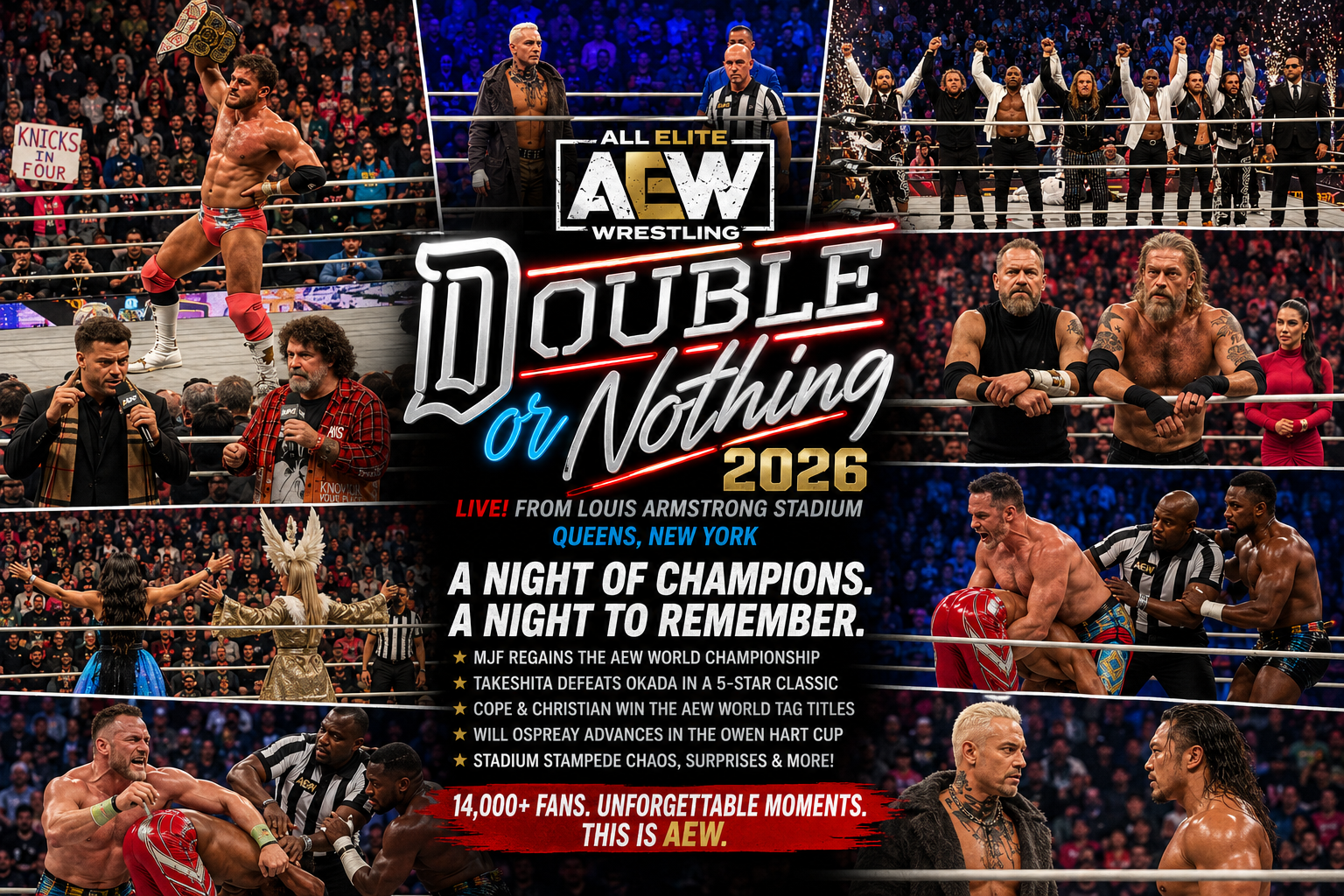
From six rows back next to the hard camera inside Louis Armstrong Stadium, All Elite Wrestling delivered one of the strongest pay-per-views of 2026 with Double or Nothing — a show that blended brutality, emotion, athleticism, nostalgia, chaos, and storytelling into one unforgettable night.
Over 14,000 fans packed the stadium in Queens and by the end of the evening, the biggest winner was not just MJF.
It was AEW itself.
Mick Foley’s Presence Matters More Than Another Match Ever Could
Before the bell even rang, there was already a special feeling in the air.
Renee Paquette introducing Mick Foley during the preshow immediately gave the event a sense of importance. Foley being associated with AEW is a genuinely exciting thing for the wrestling industry.
Not because anyone wants to see Mick Foley wrestle again.
Nobody needs that.
What AEW needs is Mick Foley’s mind.
Foley represents creativity, emotional storytelling, unpredictability, and understanding how to connect audiences to characters. Few wrestlers in history understood emotional investment better than Foley. Watching him interact with MJF and Darby Allin during the preshow felt meaningful because it connected generations of wrestling storytelling together.
And once again, MJF proved why he may be the best overall performer in professional wrestling today.
Whether it was interacting with Foley or previously working alongside Sting, MJF has a unique ability to elevate the people around him. Great performers don’t just get reactions for themselves — they raise the intensity and credibility of everyone sharing the ring with them.
That is exactly what MJF does.
Megan Bayne Looks Like a Future Centerpiece
The Zero Hour portion of the event quietly revealed a major takeaway about AEW’s women’s division.
Megan Bayne feels like a future star.
She has presence. She carries herself like a big-time attraction. There are flashes of Charlotte Flair in the confidence and presentation, but with mobility and explosiveness that at times even resembles Rhea Ripley.
AEW’s women’s division currently feels uncertain.
With Mercedes Moné absent and Toni Storm away, there feels like a vacuum creatively. There is opportunity available, but the division currently lacks a clearly defined centerpiece direction.
That creates opportunity for someone like Bayne.
On another positive note, seeing Anna Jay and Tay Melo return to the spotlight was refreshing. Both women have been loyal AEW talents dating back to the pandemic era and deserve another meaningful opportunity to contribute.
The Death Riders Story Feels Like It Has Run Its Course
One of the more interesting crowd reactions of the night came during the Death Riders’ appearance against The Opps.
The audience did not fully reject the Death Riders, but there was obvious hesitation regarding who fans wanted to support. Eventually, the crowd leaned toward The Opps, particularly with HOOK involved.
The difficult reality is this:
The Death Riders storyline may have reached its ceiling.
Claudio Castagnoli remains one of the most criminally underutilized wrestlers in the industry. Claudio can work with anyone — cruiserweights, heavyweights, technical wrestlers, brawlers — and still somehow feels held back creatively.
Wheeler Yuta and Daniel Garcia are exceptional talents too, but at some point these wrestlers need room to establish themselves individually again.
The original mission of the Death Riders under Jon Moxley was fascinating because it seemed designed to reshape AEW philosophically. Whether it was intended to lead to a bigger reveal or long-term evolution remains unclear.
But now?
It feels like the faction may be stalling some of the very wrestlers it was supposed to elevate.
Eventually, this story has to evolve or end.
Shane Taylor Promotions, AJ Boom, and Why Wrestling Is Supposed to Be Fun
One of the things that AEW has always tried to balance is serious professional wrestling with the idea that wrestling can still be entertaining, unpredictable, and flat-out fun. That was one of the biggest reasons the match involving Shane Taylor, The Conglomeration, and Boom & Doom worked so well live inside Louis Armstrong Stadium.
The crowd was invested from the moment the entrances began because the match embraced something wrestling occasionally forgets:
Not everything has to be ultra-serious to be effective.
AJ Boom brought an energy to the building that honestly surprised people who may not have fully understood his popularity beforehand. The audience reaction was genuine. Fans were smiling. Fans were chanting. Fans were reacting to everything he did because AJ understands one of the oldest rules in professional wrestling — connection matters more than complexity.
You can do every move in the world, but if the audience does not emotionally attach themselves to you, none of it matters.
AJ Boom connects.
And part of what makes him so unique is that he does not come across like a polished, corporate wrestling creation. He feels authentic. He feels like somebody having the time of his life in the ring, and the fans embrace that energy because it feels real.
What made the entire presentation even better was the involvement of his family, including Big Justice. Wrestling has always been at its best when audiences feel emotionally connected not only to the wrestlers, but to the personalities and worlds surrounding them. Watching the crowd react to AJ and his family was a reminder that wrestling can still create joy in the simplest ways.
Sometimes wrestling fans — especially online — overcomplicate what works.
Not every performer needs to be a technical wizard.
Not every match needs to reinvent the industry.
Not every segment needs to be dark and edgy.
Sometimes the purpose is simply to entertain people.
And that is exactly what AJ Boom brought to Double or Nothing.
There was an authenticity to the reaction inside the stadium. Fans were laughing, cheering, participating, and enjoying themselves. It became less about “work rate” and more about creating a memorable atmosphere, which is what professional wrestling has always been about at its core.
AEW fans embraced AJ because he embraced them right back.
That matters.
The match itself did not try to be something it was not. It was designed to energize the audience before the main card while mixing together established veterans like Orange Cassidy, Mark Briscoe, and Roderick Strong with newer personalities and different styles.
And honestly, it worked beautifully.
Copeland and Christian vs. FTR Delivered Old-School Violence Done Right
The first official match on the main card featured Adam Copeland and Christian Cage battling Dax Harwood and Cash Wheeler in a brutal “I Quit” street fight.
The stipulation was simple:
If Copeland and Cage lost, they could never tag together again.
This was violence with purpose.
The comedy was measured correctly. The brutality never crossed into self-parody. The flaming table spot involving Beth Phoenix and Stokely Hathaway was outstanding because it refreshed an overused hardcore wrestling trope in a creative way.
And perhaps most importantly, the match felt emotional.
Copeland has openly acknowledged he can see the end of his career approaching. That reality added gravity to everything happening in the ring.
The only lingering question afterward is:
Now what?
AEW’s tag division now revolves around veterans in their 50s while FTR still arguably remains the best pure tag team in wrestling today. With rumors continuing about WWE interest once FTR’s contracts expire, AEW’s tag division suddenly feels like a fascinating story to monitor moving forward.
Okada vs. Takeshita Was Professional Wrestling at Its Finest
As much as the night helped continue building Kyle Fletcher into one of AEW’s top rising heels, the real centerpiece of this entire segment of the show was the match itself between Kazuchika Okada and Konosuke Takeshita.
Quite simply, it was phenomenal.
From the opening bell, there was a different feeling inside Louis Armstrong Stadium. Fans knew they were watching two world-class performers operating at an elite level, and by the middle portion of the match the crowd became completely invested emotionally.
The “Fight Forever” chants were not forced.
They were earned.
What made the match so special was how different it felt stylistically from almost everything else on the card. This was the perfect example of the presentation and pacing that made Japanese wrestling resonate globally for decades. The match was built around timing, escalation, striking, counters, and emotional tension rather than nonstop chaos.
Every movement mattered.
Every counter mattered.
Every strike mattered.
Okada was brilliant in the heel role. There was arrogance in everything he did. He wrestled with the confidence of somebody who fully believed he was superior to everyone else in the ring and in the company itself. The subtle facial expressions, the pacing, the control he had over the audience — it was master-level wrestling psychology.
And then there was Takeshita.
This match felt like a defining moment for him as a singles star.
The audience completely rallied behind him as the match progressed. The physical charisma, the explosiveness, the emotion, the athleticism — everything connected. Takeshita came across like a legitimate future cornerstone performer for AEW.
What stood out most live was how physical the match felt in person.
The strikes sounded vicious.
The counters looked smooth.
The near falls had the audience biting on everything.
This was not just a “good match.”
This was one of those matches that reminds people why they fell in love with professional wrestling in the first place.
It combined athletic greatness with emotional investment, which is the sweet spot every great wrestling match tries to achieve.
And while the post-match angle involving Fletcher and the Don Callis Family furthered future storylines effectively, nothing should overshadow the fact that Okada and Takeshita delivered one of the best pure wrestling matches of the entire year.
It was a modern wrestling classic.
The type of match fans will still be talking about months from now when discussing the best matches of 2026.
Fletcher teased the idea of turning away from the Don Callis Family only to swerve the audience and align himself even deeper with the group. It was a simple but effective storytelling move because it reinforced Fletcher as a manipulative, dangerous heel instead of rushing him into a babyface role too early.
There was also a subtle tease involving the International Championship after the match that could lead to major future storylines down the road.
But the biggest takeaway remained Fletcher himself.
He looks comfortable in major moments.
He feels believable.
And most importantly, the crowd reacts to him like somebody who matters.
That is not something you can manufacture overnight.
Jon Moxley Still Feels Like the Soul of AEW
Seeing Jon Moxley wrestle live in person reminds you why he has become synonymous with AEW itself.
Moxley is not the flashiest wrestler in the company.
He is not the smoothest technical performer.
He is not built around elaborate entrances or overproduced presentation.
What Moxley brings is authenticity.
When he walks into an arena, fans believe him. Every movement feels real. Every punch, every submission attempt, every facial expression carries intensity. He feels like a fighter, and in professional wrestling, believability is one of the hardest things to create.
Watching him battle Kyle O’Reilly inside Louis Armstrong Stadium was another reminder of why Moxley has become one of the foundational pillars of AEW since the company began.
This was not a flashy match.
This was gritty.
Physical.
Violent.
Emotional.
And it worked because both men understood exactly what kind of story they were trying to tell.
For Moxley, this felt like redemption.
The last time he faced O’Reilly, Moxley was unraveling emotionally after losing the AEW World Championship to Hangman Adam Page at All In. That version of Moxley looked uncertain, angry, and mentally exhausted.
This version felt completely different.
Focused.
Dangerous.
Confident.
There was a calm brutality to Moxley throughout the match that made him feel once again like one of the most dangerous men in the entire company. Every strike looked painful. Every submission felt like he was trying to physically break O’Reilly apart.
And yet, as great as Moxley was, this match also became another reminder of just how underappreciated O’Reilly truly is.
The unfortunate reality for O’Reilly is that much of his mainstream American wrestling identity became tied to The Undisputed Era during his time in WWE’s NXT system alongside Adam Cole, Bobby Fish, and Roderick Strong.
That group changed NXT forever.
But sometimes being part of something legendary can unintentionally overshadow how individually talented somebody actually is.
Kyle O’Reilly is outstanding.
His striking feels legitimate. His grappling feels authentic. His pacing is excellent. He wrestles like somebody who truly understands combat sports, which makes everything he does feel grounded in realism rather than performance.
Against Moxley, O’Reilly did exactly what a great challenger is supposed to do.
He made people believe.
Even when the audience expected Moxley to survive, O’Reilly created tension with every submission attempt and every exchange because his offense looked believable enough to end the match at any moment.
That is incredibly difficult to do in wrestling.
The crowd in New York respected him because they understood they were watching a genuinely elite wrestler work against one of the faces of the company.
And honestly, AEW could benefit from leaning more into performers like O’Reilly.
He does not need elaborate gimmicks.
He does not need excessive theatrics.
He just needs meaningful opportunities.
Because every single time he is given real ring time, he delivers.
The chemistry between both men elevated the entire match. Moxley brought the intensity and emotional presence while O’Reilly brought technical realism and urgency. Together, they created one of the most believable fights on the entire card.
Eventually, the Death Riders storyline will likely come to an end, and when it does, AEW needs to seriously evaluate what comes next for Moxley.
Because while he has thrived as the ruthless leader of the faction, there is still tremendous value in eventually transitioning him back into the company’s top babyface role.
Few wrestlers in modern wrestling feel as authentic as Jon Moxley.
And after Double or Nothing, one thing became crystal clear again:
Jon Moxley still feels like the soul of AEW.
Will Ospreay Might Be AEW’s Next Mega Babyface
If there was any remaining doubt about who AEW’s next great babyface could be, Will Ospreay erased it Sunday night.
Everything about Ospreay connects.
The entrance.
The movement.
The intensity.
The pacing.
The emotion.
Fans are fully invested in him.
His match against Samoa Joe was sensational.
And Samoa Joe deserves enormous credit as well.
Joe remains one of the most believable wrestlers in the business. No matter his age, when Samoa Joe enters a title picture or major match, audiences instantly buy him as a legitimate threat.
That credibility cannot be taught.
Ospreay defeating Joe in the Owen Hart Tournament felt like another major step toward AEW fully positioning him as one of the faces of the company moving forward.
Swerve Strickland Needs to Become Dangerous Again
One of the strongest performances of the night came from Swerve Strickland against Bandido.
Swerve remains one of the best signings AEW has ever made.
But creatively, there is an important realization AEW must embrace:
Swerve works best as a dangerous heel.
The cool, unpredictable, threatening version of Swerve feels special. The darker presentation gives him edge and unpredictability.
Professional wrestling needs villains that feel dangerous.
Swerve can absolutely become that.
The match with Bandido exceeded expectations because both men wrestled with urgency and intensity, but the bigger takeaway was Swerve’s overall presentation.
The updated music.
The aura.
The confidence.
Everything about him screamed superstar.
Prince Nana dancing and some of the lighter presentation aspects are entertaining, but at his absolute best, Swerve should feel like AEW’s version of Darth Vader — calm, dangerous, unpredictable, and capable of ending somebody’s night instantly.
That version of Swerve feels main-event level.
And AEW should lean into that moving forward.
The Women’s Division Still Feels Like AEW’s Biggest Creative Question
The four-way women’s championship match featuring Jamie Hayter, Kris Statlander, Hikaru Shida, and Thekla perfectly represented both the strengths and weaknesses currently surrounding AEW’s women’s division.
The effort was there.
The talent was there.
The crowd support was there at times.
But there was still an overall feeling of uncertainty surrounding the division’s direction.
Part of that is simply bad timing. Mercedes Moné being absent changes the entire presentation of the division because she carries mainstream star power. Toni Storm being away leaves another major creative void. Willow Nightingale relinquishing the TBS Championship also shifted momentum unexpectedly.
As a result, the division currently feels like it is searching for its identity again.
That does not mean the division lacks talent.
Far from it.
Jamie Hayter still feels like somebody fans desperately want to rally behind because of her intensity and toughness. Kris Statlander remains one of the strongest all-around athletes in the company. Hikaru Shida continues to bring consistency and credibility whenever she performs. And Thekla has a unique aura that immediately stands out visually and stylistically.
The issue is not talent.
The issue is direction.
At times, it felt like the audience was watching talented wrestlers compete without fully understanding what the long-term vision for the division currently is. That uncertainty affects crowd investment, especially on a card loaded with emotionally driven men’s storylines that had clearer momentum.
Still, credit absolutely belongs to the women involved because they worked extremely hard to make the audience care. The effort and professionalism were obvious throughout the match.
And perhaps the most important takeaway is this:
AEW still has time to fix it.
The foundation is there.
The roster is there.
The potential is absolutely there.
Now the company simply needs to establish a clearer identity and direction for the women’s division moving forward.
Stadium Stampede Was Pure Wrestling Madness
Then came complete insanity.
The Stadium Stampede match was exactly what it needed to be:
Chaotic.
Violent.
Funny.
Ridiculous.
Entertaining.
The baseball jersey entrance.
The tennis ball spots.
The comedy.
The brutality.
Everything blended together perfectly inside a stadium environment inspired by the U.S. Open setting.
Chris Jericho once again showed why he understands spectacle better than almost anyone in wrestling history.
The match never tried to be serious art.
It tried to entertain people.
And it succeeded completely.
MJF Reclaims His Throne
Finally came the main event.
MJF vs. Darby Allin for the AEW World Championship in a Hair vs. Title match.
The crowd expected surprises.
Instead, AEW gave them storytelling.
Darby’s entire story revolved around self-destruction. He sacrifices his body constantly, and eventually that recklessness catches up to everyone.
MJF exploited that perfectly.
The coffin drop off the stage through the table was spectacular. The piledriver on the steps was brutal. The tombstone finish from the top rope felt definitive and violent.
And in the end, MJF became only the second three-time world champion in AEW history.
Then came another major moment.
Kevin Knight appeared to save Darby before shockingly turning on him.
MJF’s reaction afterward was subtle brilliance.
He didn’t look shocked.
He looked intrigued.
Plotting.
Calculating.
Exactly how a world champion villain should behave.
And while Darby’s reign lasted barely over a month, he proved something important:
Darby Allin absolutely can carry AEW when called upon.
Final Thoughts
When the show ended and fans poured out into the New York night, there was one overwhelming feeling:
AEW had delivered.
Not every storyline is perfect. Not every division feels fully organized. There are still questions creatively.
But on this night, none of that mattered.
All Elite Wrestling produced one of the best professional wrestling pay-per-views of 2026.
Some stories ended.
Some stories evolved.
Some new stars emerged.
But at the center of everything stood one man once again.
MJF.
The AEW World Champion.
Right where he believes he belongs.

Featured Articles




Featured Writers