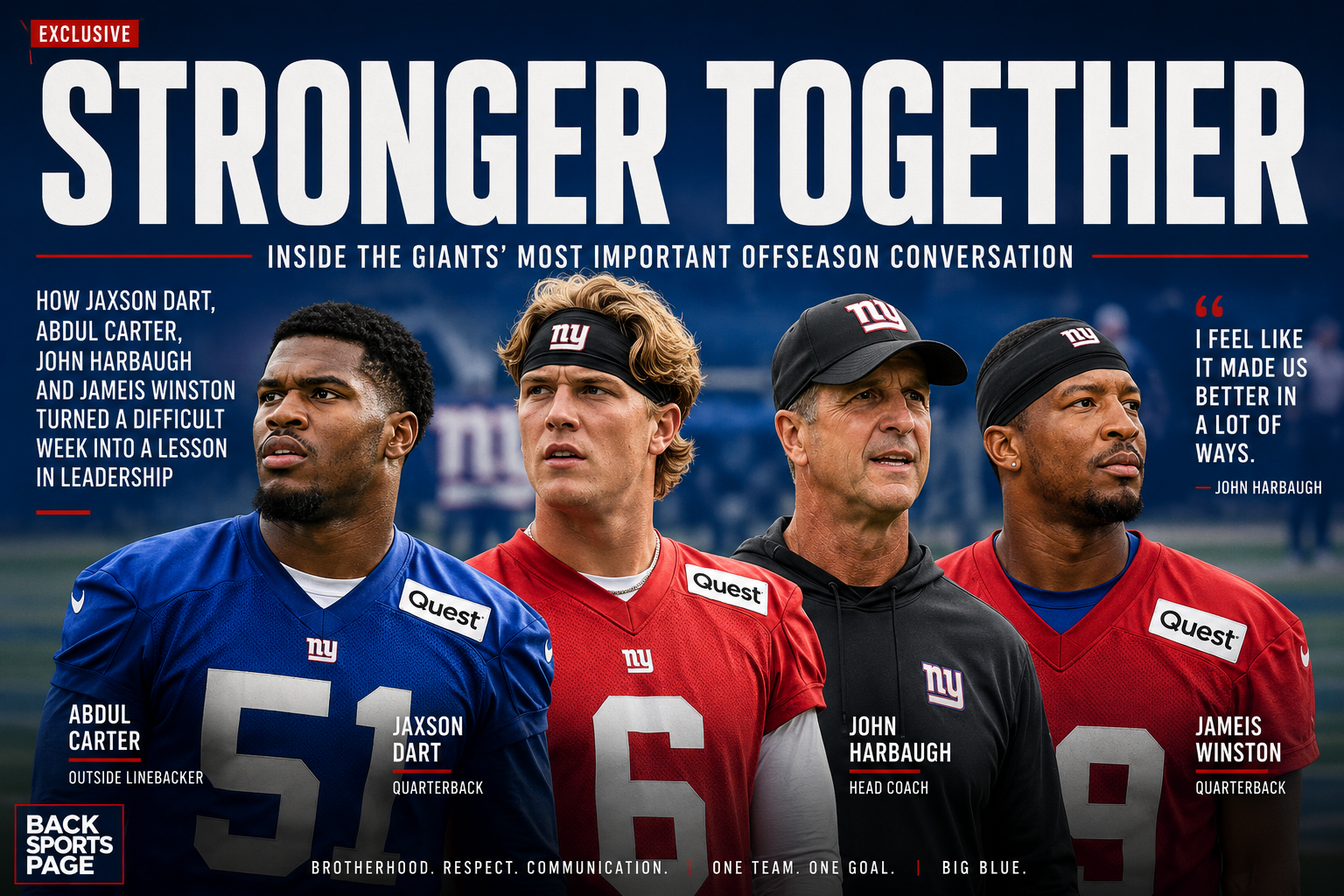
John Harbaugh has spent more than two decades coaching professional football. He has guided teams through playoff races, championship runs, devastating injuries, heartbreaking defeats and the daily pressures that come with leading an NFL locker room.
Yet when he stood before reporters following Friday’s OTA practice, Harbaugh wasn’t discussing coverages, quarterback play or roster battles.
Instead, he was discussing communication.
He was discussing respect.
Most importantly, he was discussing growth.
“I feel like it made us better in a lot of ways,” Harbaugh said.
The “it” Harbaugh referred to was an unexpected off-field controversy involving quarterback Jaxson Dart and outside linebacker Abdul Carter—one that briefly became a national conversation and threatened to create unnecessary distractions during a critical stage of the Giants’ offseason program.
Instead of allowing the situation to become divisive, however, the Giants chose a different path.
They talked.
And in doing so, Harbaugh believes they took another step toward becoming the type of football team he wants to build.
A Moment Bigger Than Football
The situation began when Dart appeared publicly to introduce the President of the United States during a recent event.
The appearance generated significant reaction on social media and eventually prompted a public response from Carter, one of the Giants’ young defensive leaders and fellow member of the franchise’s 2025 draft class.
What followed could have easily become a source of tension.
Instead, it became a lesson in leadership.
Harbaugh understood immediately that the issue extended beyond football.
Rather than avoiding the conversation, he embraced it.
“It was a great opportunity for us as a football team to have these kind of conversations around a real-life incident,” Harbaugh said. “It’s one thing to talk about these things in theory. It’s another thing when something real happens.”
The veteran coach resisted the temptation to dictate how players should think or feel.
Instead, he gathered veterans and leaders inside the locker room and encouraged dialogue.
The message was simple.
This wasn’t about politics.
It wasn’t about public perception.
It was about how teammates communicate when they see things differently.
“We are a collection of all of us together,” Harbaugh explained. “It’s your team. What you want the focus to be on and what you want to be about going forward is really up to you guys.”
For a first-year head coach attempting to establish a culture, the response from the players may have been exactly what he hoped to see.
The Weight of the Quarterback Position
Few positions in sports carry the responsibility that comes with being quarterback of the New York Giants.
Dart understands that.
The former first-round pick entered the offseason as the face of the franchise and one of the central figures in the organization’s future.
Every decision is analyzed.
Every statement is scrutinized.
Every action carries significance.
Dart acknowledged that reality during his media session Friday.
“I understand that I am the quarterback of the New York Giants, and that involves a lot of responsibility,” Dart said. “I’m under a microscope, and there’s a lot that comes with it.”
While Dart declined to engage in a broader political discussion, he repeatedly emphasized what mattered most to him—the relationships he has built inside the Giants’ locker room.
He spoke about teammates.
He spoke about trust.
He spoke about brotherhood.
And he made it clear that none of those relationships had changed.
“I love every single one of my brothers, my teammates on this team,” Dart said. “Regardless of politics, regardless of religious beliefs, regardless of anything that may be different between us.”
The comments reflected a young quarterback learning one of the most difficult realities of NFL leadership.
Leadership isn’t tested when everything is going smoothly.
Leadership is tested when circumstances become uncomfortable.
Abdul Carter’s Perspective
If Dart represented one side of the conversation, Carter represented another.
The talented linebacker never backed away from his beliefs.
He made it clear why he chose to speak publicly.
At the same time, he made something equally clear.
Disagreement does not automatically create division.
“Jaxson is one of our leaders. He’s the face of our franchise,” Carter said. “But if he chooses to align himself with a man like President Trump, it’s my responsibility based on what I believe and what I stand on to not only show my teammates that I’m against that, but to show the world.”
What stood out most was not Carter’s criticism.
It was his perspective afterward.
Despite disagreeing with Dart’s decision, Carter repeatedly described their relationship as strong.
The two players entered the league together.
They have shared experiences, challenges and expectations since arriving in New York.
That relationship never changed.
“Just because we have a disagreement on something doesn’t mean that there is something more than that,” Carter said. “It’s just a disagreement and we can talk about it as men, which we did, and move forward from it.”
Perhaps the most revealing moment came when Carter was asked whether Dart apologized.
His answer spoke volumes.
“No. I don’t want him to say he’s sorry. Stand on what you believe in. But it can’t be a problem when I stand on what I believe in.”
In many ways, that statement captured the entire week.
The Giants were not trying to create agreement.
They were trying to create understanding.
Why Jameis Winston Matters
Every successful NFL locker room needs veteran leadership.
For the Giants, few players are better equipped to provide it than Jameis Winston.
Throughout his career, Winston has experienced nearly every situation imaginable.
Success.
Failure.
Praise.
Criticism.
Growth.
His perspective Friday reflected those experiences.
Rather than viewing the situation as a conflict, Winston viewed it as an opportunity.
An opportunity for young players to learn.
An opportunity for teammates to communicate.
An opportunity for a locker room to become stronger.
“We don’t have to agree,” Winston said. “We don’t have to understand people’s perspective. But I think we should support their perspective because that’s what they believe in.”
Winston’s message centered on togetherness.
Football teams are unique environments.
Players arrive from different parts of the country.
Different backgrounds.
Different cultures.
Different life experiences.
Yet for several months each year, they are asked to become one.
That process isn’t always easy.
The Giants experienced that reality firsthand this week.
According to Winston, they handled it exactly the right way.
“I’m proud of Jaxson and Abdul for having this conversation,” Winston said. “I’m proud of our team for understanding we don’t have to pick a side in this.”
Those words likely resonated throughout the locker room.
Because ultimately, that is what championship-caliber teams do.
They communicate.
They adapt.
They grow.
Building the Harbaugh Culture
Since arriving in New York, Harbaugh has consistently spoken about building a foundation.
Not just a football foundation.
A cultural foundation.
The veteran coach wants a team capable of handling adversity, criticism, success and failure.
He wants players who communicate.
He wants leaders who listen.
Most importantly, he wants a locker room built on mutual respect.
This week provided an unexpected opportunity to reinforce those values.
Instead of splintering, the Giants responded by coming together.
Instead of avoiding difficult conversations, they confronted them.
Instead of allowing outside voices to define the situation, they handled it internally.
That is why Harbaugh believes the team emerged stronger.
Not because everyone suddenly agreed.
But because they proved they could disagree and still move forward together.
As OTAs continue and training camp approaches, the Giants still face plenty of football questions.
Can Dart take the next step as a franchise quarterback?
Can Carter become the defensive difference-maker many believe he can be?
Can Harbaugh return the Giants to playoff contention?
Those answers will come later.
For now, the Giants learned something important about themselves.
They learned that adversity doesn’t always arrive on Sundays.
Sometimes it arrives in the middle of the offseason.
Sometimes it has nothing to do with football.
And sometimes, if handled correctly, it can help build the very culture that winning teams depend on.
If Harbaugh is right, that’s exactly what happened this week.

Featured Articles



Featured Writers