There are certain moments in professional wrestling that exist almost entirely in the imagination of the fans.
You picture the entrance, you picture the crowd reaction, you picture the match and, for a brief moment, you allow yourself to believe that maybe, somehow, it could actually happen. Then reality sets in.
Contracts, corporate relationships, television rights, brand protection and everything else that exists behind the curtain remind you that professional wrestling is still a business.
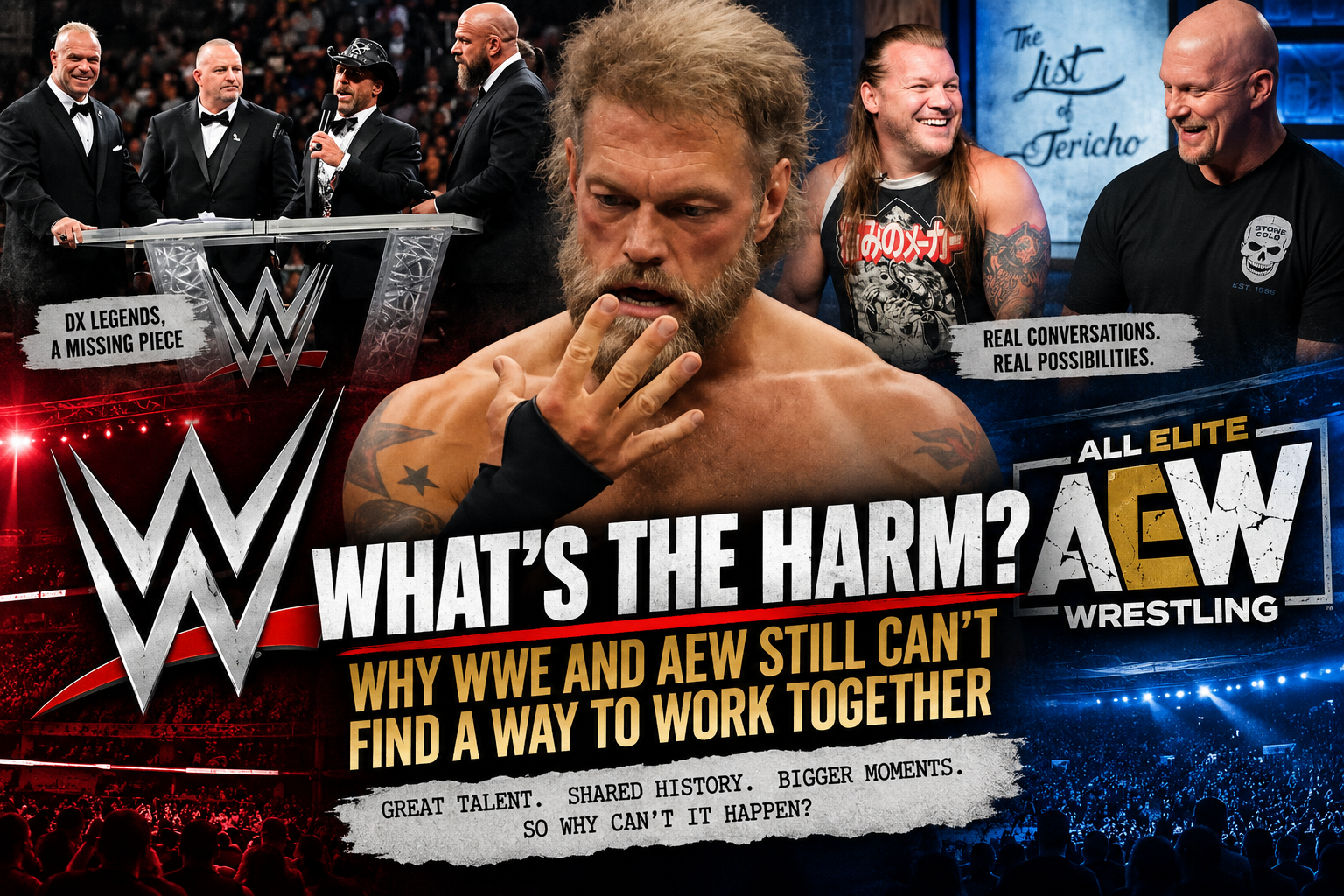
Adam Copeland’s recent appearance on Ariel Helwani’s show brought one of those moments back to the forefront. During a discussion about John Cena’s farewell tour, Copeland was asked about the possibility of one final match between two wrestlers whose careers became so closely intertwined during WWE’s Ruthless Aggression era.
Copeland said he believed Tony Khan would have allowed him to make a one-off appearance for WWE to wrestle Cena. He also made it clear that he understood how WWE operates and believed the obstacle would have been on WWE’s side. Importantly, Copeland acknowledged that he was making an assumption based on his experience and understanding of the company; there were never formal negotiations over the match.
That distinction is important because Copeland wasn’t speaking like someone with an axe to grind. He didn’t leave WWE after being fired. He didn’t walk away under contentious circumstances.
His contract expired, and he made a choice. At that stage of his career, Copeland felt he had accomplished essentially everything he could accomplish in WWE and wanted to see what else was possible. AEW offered him fresh opponents, different creative opportunities and the chance to work with wrestlers he had never shared the ring with.
He has continued to speak positively about what WWE gave him while being equally open about how much he enjoys his life and career in AEW.
In fact, Copeland has said that AEW’s environment helped reinvigorate him and that he now expects to finish his career there.
That is what makes his comments so interesting. This wasn’t a former WWE wrestler complaining about his old employer. This was somebody who has genuinely lived on both sides of the fence.
He understands WWE. He understands AEW. He understands the business considerations that come with putting one company’s contracted talent on another company’s television, but he also understands what it means to a fan when two pieces of wrestling history can come together for one special moment. And that brings me to the question I keep coming back to: what’s the harm?
To be clear, I’m not suggesting that WWE and AEW should stop competing. Quite the opposite. Competition has been one of the healthiest developments in professional wrestling over the last several years.
When AEW launched, wrestlers suddenly had another major destination. Talent had more leverage. Fans had another major product to watch. WWE could no longer operate in a marketplace where it was effectively the only major game in town. Whatever you think of AEW’s creative decisions, its existence has changed the wrestling business, and I believe that has been good for the industry.
I’m also not arguing that WWE should suddenly become AEW’s best friend. AEW has its own problems, just as WWE does. Both companies make decisions I like, and both make decisions that leave me scratching my head.
I don’t believe fans should have to choose one company and automatically dislike the other. I can enjoy WWE and AEW for completely different reasons, and I think there’s room in professional wrestling for both.
What I’m questioning is whether competition has to mean that every possible opportunity for cooperation is automatically off the table.
Because there is history here, and we shouldn’t ignore it.
When AEW launched, the company took plenty of shots at WWE. Cody Rhodes did it. CM Punk did it. MJF did it. The Young Bucks did it. AEW was positioning itself as the alternative, and WWE was naturally the company against which that alternative was being measured.
MJF’s famous promos about WWE and his frustration over Tony Khan bringing in former WWE talent became part of the company’s identity. AEW wasn’t quietly entering the marketplace; it was openly challenging the established order.
WWE responded in its own way. During D-Generation X’s 2019 Hall of Fame induction, Triple H joked about Vince McMahon buying the company Billy Gunn was working for so he could fire Gunn again, while Shawn Michaels made a reference to Gunn being “all in,” a clear nod to AEW’s launch-era identity.
But I don’t think those comments should be turned into something they weren’t. That was DX doing what DX does. It was sarcasm, it was banter and it was part of the group’s irreverent personality. It wasn’t some major corporate declaration that WWE would never acknowledge AEW.
Still, it demonstrated that the rivalry existed almost immediately. Both companies knew what the other represented, and both had reasons to keep their distance.
But relationships change, and the wrestling business has changed considerably since 2019.
Cody Rhodes is now one of WWE’s biggest stars. CM Punk is back in WWE. Wrestlers have moved in both directions. AEW is no longer the brand that was trying to establish itself on TNT. WWE is operating under TKO and has become even more deeply integrated into a larger sports and entertainment business.
Tony Khan’s public approach has also evolved. He has increasingly presented AEW as a company willing to work with other wrestling organizations when there is a reason to do so.
That doesn’t mean Tony Khan would agree to everything WWE asked. He shouldn’t. He’s a businessman, and if AEW talent is going to appear on WWE programming, AEW should receive something of value in return. That’s simply how business works.
But AEW has demonstrated a willingness to make exceptions.
Look at the John Cena tributes. When WWE wanted AEW talent to participate in video messages celebrating Cena, Tony Khan allowed it. Wrestlers from AEW were able to acknowledge a WWE star and celebrate his career without turning the situation into an angle or using the opportunity to promote AEW. It was simply professional wrestlers paying tribute to another wrestler who had made an enormous impact on the industry.
Chris Jericho’s appearance with Steve Austin is another interesting example, although the circumstances there were particularly unique. Jericho wasn’t just another former WWE wrestler who happened to be working for AEW. He had a long history with WWE, a relationship with Vince McMahon and a strong personal relationship with Austin. Jericho has discussed how Tony Khan was initially nervous about the appearance before ultimately approving it. The situation made sense because everyone understood what it was: two major wrestling personalities having a conversation.
Nothing catastrophic happened. Jericho didn’t suddenly become less valuable to AEW. WWE didn’t suddenly become more powerful. AEW didn’t lose its identity. It was simply a one-off moment.
And that’s where Billy Gunn comes into this conversation.
When WWE celebrated the 25th anniversary of D-Generation X in 2022, there was an obvious absence. Triple H was there. Shawn Michaels was there. Road Dogg was there. X-Pac was there. But Billy Gunn, one of the founding members of the group and one-half of the New Age Outlaws, was not.
At the time, Gunn was working for AEW as part of The Acclaimed. Gunn later discussed the situation with Chris Van Vliet on his Insight podcast and characterized what happened as a miscommunication. His comments also demonstrated that he understood the complicated position he was in. He was under contract to AEW, and if the companies couldn’t make the appearance work, he wasn’t going to simply show up on WWE television without permission. Wrestling Inc.’s report on Billy Gunn’s Chris Van Vliet interview
The circumstances surrounding the appearance make the story even more interesting. According to the reporting, AEW was willing to allow Gunn to participate, but Tony Khan wanted WWE to acknowledge that Gunn was working for AEW and that AEW had given him permission to appear. WWE ultimately decided it did not want to promote its direct competitor, and the appearance never happened.
I understand WWE’s argument. I really do. If you’re WWE, why put an AEW graphic on your television? Why give another wrestling company exposure to your audience? Why promote a company that is competing with you for viewers, talent and attention? From a corporate perspective, those are legitimate questions.
But as a fan, I can’t help looking at the other side of it.
Billy Gunn could have walked onto RAW, stood beside Triple H, Shawn Michaels, Road Dogg and X-Pac, soaked in the reaction from the crowd and celebrated the history they shared. He could have done his part, the segment could have ended, and he could have gone back to AEW the next day.
There didn’t need to be an invasion.
There didn’t need to be an AEW championship involved.
There didn’t need to be a storyline.
WWE didn’t have to suddenly become an AEW partner.
It could have simply been Billy Gunn coming home for one night to celebrate something he helped create.
And, according to the reporting, AEW was willing to help make that happen.
That’s what I find frustrating.
Not because WWE was obligated to do it. It wasn’t. Not because AEW was entitled to WWE’s television platform. It wasn’t. But because it was such a small thing that could have created such a memorable moment.
One of the founding members of D-Generation X could have stood with the group during its 25th anniversary celebration, and instead that moment simply didn’t happen.
And this is where WWE’s current relationships with other wrestling organizations make the situation even more interesting.
WWE has demonstrated that it can work with outside promotions when it sees a benefit. In January 2025, WWE and TNA formally announced a multi-year partnership that allows NXT and TNA talent to cross over between the two companies’ programming, including appearances on weekly television and premium events.
WWE itself described the partnership as creating crossover opportunities and talent-development benefits.
WWE has also taken an entirely different approach with AAA. Rather than simply partnering with the Mexican promotion, WWE announced in 2025 that it had acquired AAA in partnership with Fillip, while still maintaining AAA’s identity and heritage.
The acquisition was accompanied by Worlds Collide, bringing WWE and AAA talent together on the same event.
Those examples don’t prove that WWE should work with AEW. In fact, they help explain why WWE might view AEW differently. TNA is a competitor, but it isn’t competing with WWE on the same scale as AEW. AAA operates in a different market and became a strategic acquisition rather than a direct rival relationship. AEW is different.
AEW is the major North American promotion that competes most directly with WWE for television viewers, talent, fans and attention.
So if you’re sitting in a WWE boardroom, the question is perfectly reasonable: What do we gain by helping AEW?
And that’s where I think WWE has a legitimate point. AEW probably has more to gain from a relationship with WWE than WWE does. AEW would get exposure.
AEW talent would get the rub of appearing on WWE programming. AEW would gain credibility with an even larger audience. WWE doesn’t need any of those things from AEW.
But here’s where I think the conversation becomes bigger than a balance sheet.
Professional wrestling is an emotional business.
The fans aren’t buying quarterly earnings reports. They’re buying tickets because they want to see moments. They’re watching television because they want to be surprised. They’re spending money on merchandise because particular wrestlers and particular stories mean something to them.
Twenty years from now, most fans aren’t going to remember what a company’s operating margin was in a particular quarter. They’re going to remember the first time a certain wrestler returned. They’re going to remember the shocking debut. They’re going to remember the retirement. They’re going to remember the reunion that nobody thought would happen.
That’s why the possibility of Adam Copeland wrestling John Cena one final time mattered.
It wasn’t because AEW needed WWE.
It wasn’t because WWE needed AEW.
It mattered because John Cena and Adam Copeland helped define an era of WWE together. Their rivalry helped elevate both men, and Copeland himself acknowledged that their careers were pushed to another level by the story they told together.
Copeland said that if the decision had been left to him and Cena, he would have been happy to do it, while also saying he understood the perspective of the other side.
That’s the kind of moment that exists outside the normal corporate equation.
And it isn’t the first time wrestling has wrestled with this problem.
Think back to the Monday Night War. When D-Generation X attempted to invade WCW Monday Nitro, they arrived at the arena and were famously unable to get through the doors. The invasion never really happened, but the idea itself was captivating because it represented something wrestling fans weren’t supposed to see: the walls between two competing companies coming down.
Triple H has spoken about that moment from the perspective of a fan, essentially arguing that he’d rather watch a wrestling show where something unexpected happens than simply watch the same old program. That’s what made the Monday Night War so compelling. You never knew whether the impossible might happen.
Today, Triple H is in a completely different position. He’s not just a wrestler thinking about what would make for the coolest television. He’s an executive responsible for protecting WWE’s brand, talent, business interests and long-term strategy. The circumstances are different, and I don’t think it’s fair to portray his current position as some kind of contradiction.
But the contrast is fascinating.
The fan wants the moment.
The executive has to protect the business.
And sometimes those two instincts point in completely different directions.
That’s also why I don’t think this is a story about the talent.
Professional wrestling has always been a fraternity. Wrestlers who compete against each other on television can remain friends away from the ring. They train together. They communicate. They congratulate each other. They support each other’s careers. A wrestler can leave WWE for AEW, or AEW for WWE, and the personal relationships don’t necessarily disappear with the contract.
The fans can turn WWE versus AEW into tribal warfare, but the wrestlers generally understand that they’re part of the same profession.
That’s what makes the corporate separation so interesting.
The people aren’t necessarily the problem.
The companies are simply protecting their respective interests.
And I understand that.
What I don’t know is whether there are moments where protecting those interests becomes less important than creating something that fans will remember forever.
Maybe a one-night WWE-AEW supershow is unrealistic. Maybe it’s a terrible business idea. Maybe WWE would have far more to lose than it would gain. But I still think about what such an event could look like if the two companies ever wanted to get creative without sacrificing their identities.
It wouldn’t even have to be an invasion.
WWE wrestlers could wrestle WWE wrestlers.
AEW wrestlers could wrestle AEW wrestlers.
Each company could control its own matches. Each company could protect its championships. WWE could insist that its matches headline the event. AEW could get the exposure it wants, while WWE gets a massive event built around an idea that fans would immediately understand.
Would AEW gain more from it?
Absolutely.
I’m not going to pretend otherwise.
But does every business relationship have to provide exactly the same benefit to both sides? Sometimes one party gains more financially while the other gains something else. Sometimes the biggest beneficiary isn’t either company. Sometimes it’s the fans.
And maybe that’s what gets lost when every decision is reduced to the question of, “What’s in it for us?”
Sometimes the answer is simply, “This would be really cool.”
That’s not necessarily a good enough reason for a publicly traded sports-entertainment company to make a decision. I understand that. But it is the reason professional wrestling has survived for generations. Fans have always been willing to suspend disbelief for the possibility that something extraordinary might happen.
The other side of this argument has to be acknowledged, too. AEW’s early years were filled with shots at WWE. WWE would be justified in remembering that history. You can’t spend several years positioning yourself as the alternative to WWE, mocking the company and its talent, and then expect every executive on the other side to forget all of it the moment you decide you’d like to cooperate.
But people change. Companies change. The industry changes.
Cody Rhodes is now one of WWE’s biggest stars. CM Punk is back in WWE. Talent moves in both directions. AEW isn’t the same company it was in 2019, and WWE isn’t the same company it was either. At some point, every relationship has to decide whether the history matters more than the future.
I don’t think Tony Khan should get a free pass simply because he’s willing to work with WWE. AEW has made plenty of decisions that deserve criticism, and there are absolutely times when AEW’s business interests should come first. Likewise, I don’t think WWE is wrong for protecting its brand or refusing to give its biggest competitor something valuable without receiving anything in return.
That’s why I don’t want this to be another WWE-versus-AEW argument.
I’m not trying to decide who’s right.
I’m trying to explain why, as a fan, I find it disappointing that some of these moments never happen.
John Cena’s farewell tour is over. The opportunity for Adam Copeland to have one final match with one of his greatest rivals is gone. Billy Gunn didn’t get to stand alongside the rest of D-Generation X during its 25th anniversary celebration. Those opportunities don’t come back.
There will be others.
There will always be another wrestler whose career is coming to an end. Another reunion. Another tribute. Another relationship that crosses company lines. Another moment where two pieces of wrestling history happen to belong to different corporations.
And maybe most of those moments shouldn’t happen.
Maybe some aren’t worth the trouble.
Maybe some don’t make business sense.
But I hope the two companies don’t become so focused on protecting their respective territories that they forget there are times when the fans are asking for something that could be bigger than either company’s logo.
That’s ultimately what I hear in Copeland’s comments.
I don’t hear bitterness.
I don’t hear somebody trying to tear WWE down.
I hear a wrestler who understands both sides and recognizes that sometimes two stories can intersect if both companies are willing to let them.
That’s a pretty reasonable perspective.
And it’s one I think wrestling fans can understand.
We don’t have to choose between WWE and AEW. We can enjoy different styles, different wrestlers and different products. We can criticize one company one night and enjoy it the next. We can watch WWE, watch AEW, watch TNA and appreciate what each contributes to professional wrestling without turning fandom into a political party.
The companies are going to compete.
They should compete.
AEW isn’t going anywhere. WWE isn’t going anywhere. The rivalry isn’t going anywhere.
But competition and cooperation don’t have to be mutually exclusive.
Maybe there will never be a WWE-AEW supershow.
Maybe Adam Copeland and John Cena simply weren’t meant to have one final match.
Maybe Billy Gunn’s place in that DX reunion was always going to remain an empty chair.
But every once in a while, I hope the people making these decisions look beyond the immediate business calculation and ask themselves what the fans might remember twenty years from now.
Because the financial benefits of a decision can be measured immediately.
The value of a great wrestling moment can last forever.
And that’s why I keep coming back to the same question.
Not as an accusation.
Not as a demand.
Not as a WWE-versus-AEW argument.
Just as a wrestling fan who wishes we could occasionally put the logos aside and let history happen.
What’s the harm?

Featured Articles




Featured Writers