There is a certain irony to the question Andrade El Ídolo keeps asking.
“How you know?”
It has become his catchphrase, his response to doubters and, increasingly, the punctuation mark on a character that has taken years to fully develop. The phrase is funny, but there is something deeper happening with Andrade right now. For perhaps the first time in his career, he doesn’t appear to be searching for the version of himself that professional wrestling wants him to be.
He appears to have figured out who he is.
And that has made all the difference.
Andrade’s second run in All Elite Wrestling has become one of the more interesting redemption stories in professional wrestling. The wrestler was never really in question. The ability was always there. His work in Mexico, NXT and WWE established him as one of the most technically gifted performers of his generation. He could have a spectacular match with almost anyone and had the kind of athleticism and presentation that made it easy to imagine him becoming a major star.
What was harder to find was the character that could connect everything together.
That is what makes this version of Andrade different.
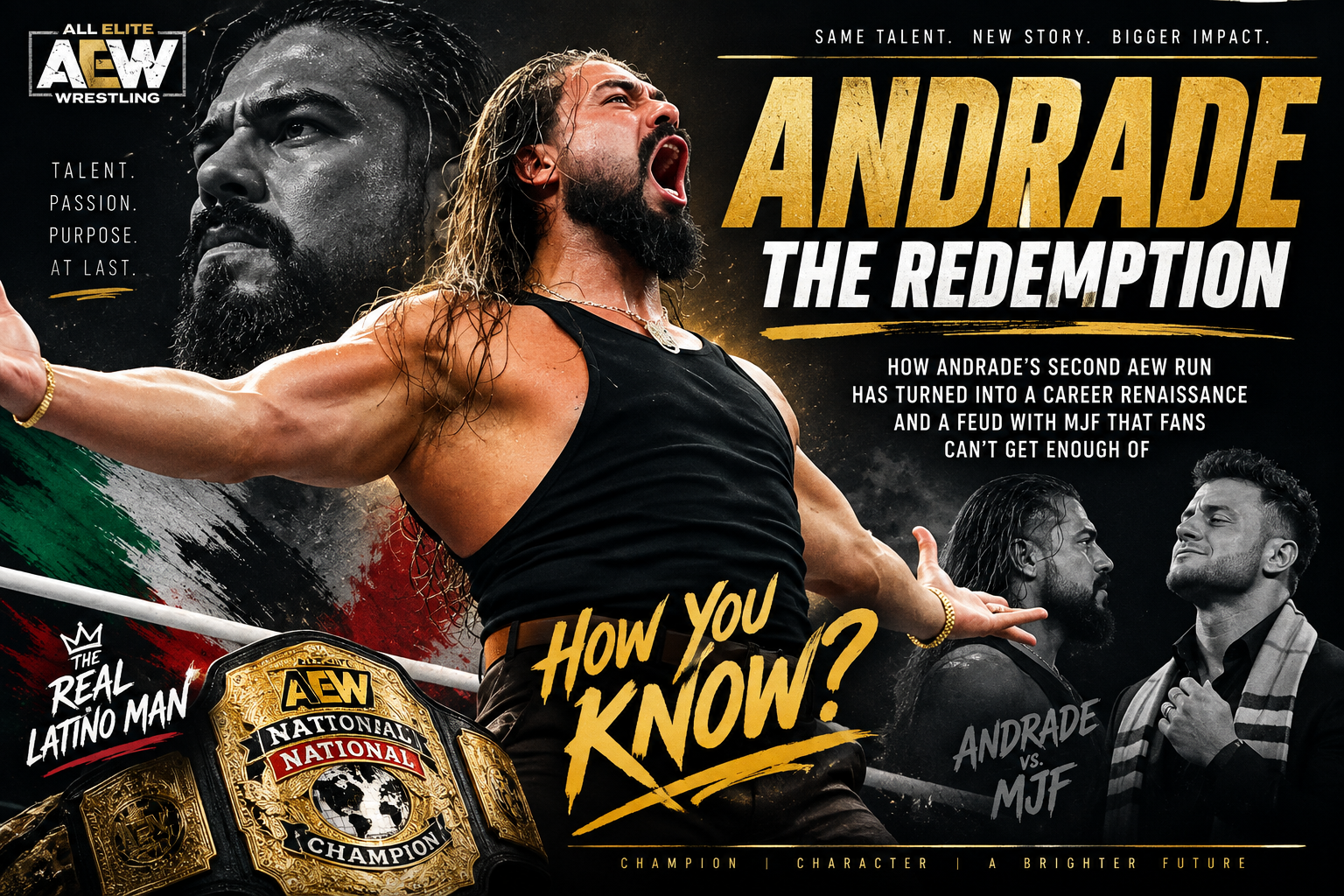
He has become the “Real Latino Man.” He has embraced the swagger, the fashion, the confidence and the humor. He has allowed himself to interact with the audience in a way that doesn’t feel forced. The selfies, the women in the crowd, the exaggerated confidence and the now-familiar “How You Know?” have created something that is bigger than a wrestling move or a championship.
It has created an identity.
And the audience has responded.
When Andrade defeated Mark Davis at AEW Redemption to become the National Champion, it wasn’t simply another title change. It was the culmination of months of momentum around a character that had slowly gotten over with the AEW audience. His “Real Latino Man” persona and “How You Know?” catchphrase had become increasingly popular, and that momentum helped move him from his association with the Don Callis Family into a more traditional babyface role.
That is the part of Andrade’s story that deserves more attention.
He didn’t suddenly become a better wrestler.
He became a better character.
And there is a significant difference.
The Andrade who left wasn’t the Andrade who returned
Andrade’s career has taken some unusual turns.
His first AEW run began in 2021 after WWE released him. He arrived with a major reputation, but his time in AEW never quite developed into what many expected. He was surrounded by talented performers, had memorable matches and worked with some of the company’s biggest names, but there was always a sense that the pieces hadn’t completely come together.
Then he went back to WWE.
Andrade has since explained that his decision to return to WWE was influenced heavily by his relationship with Charlotte Flair. At the time, the two were together and eventually married. In a later interview, Andrade discussed the personal circumstances surrounding the relationship and his eventual departure from WWE. He has also pushed back strongly against speculation that Charlotte was responsible for him being released, saying that she “never went to management to get me fired” and that he continues to respect her.
That distinction matters.
It would be easy to turn the Charlotte portion of the story into a simple wrestling narrative — Andrade left AEW to be with Charlotte, returned to WWE, their marriage ended, and Andrade eventually came back to AEW. But Andrade’s own comments make clear that the reality was more complicated, and he has specifically rejected the idea that Charlotte somehow caused his WWE problems.
The better way to look at it is that Andrade’s life and career changed dramatically during those years.
And when he returned to AEW, he returned with an opportunity to redefine himself.
This time, he took it.
AEW gave Andrade something WWE never quite found
That doesn’t necessarily mean AEW has done something WWE could never have done.
It means Andrade has found a better fit for the performer he has become.
That is an important distinction.
Professional wrestling is ultimately a partnership between the performer and the promotion. A company can give someone television time, championships and opportunities, but the wrestler still has to give the audience a reason to care.
Andrade appears to have found that reason.
The comparison to Toni Storm and Swerve Strickland is particularly appropriate.
Storm arrived in AEW already established as a highly regarded wrestler. What changed her career was the creation of “Timeless” Toni Storm. Suddenly, she wasn’t just another talented wrestler on the roster. She was a character with a world of her own, complete with old-Hollywood presentation, mannerisms and a completely different approach to performing.
Swerve Strickland’s evolution was different but produced a similar result. After leaving WWE and joining AEW, Strickland gradually developed into a much more complete character, moving from villain to antihero and eventually becoming AEW World Champion. He has spoken about wanting to create stories that extend beyond the wrestling ring, explaining that he wanted opponents to feel as though they were never completely safe from him. He also described AEW’s creative process as a give-and-take between the wrestler, Tony Khan and management.
Storm and Swerve didn’t become successful in AEW simply because they were former WWE wrestlers.
They became successful because they reinvented what the audience expected from them.
Andrade is doing the same thing.
The difference is that his reinvention is less dramatic on the surface. There is no Hollywood character. There is no completely different physical presentation. There is no radical departure from the wrestler fans knew.
Instead, Andrade has taken pieces of himself that were always there and turned the volume up.
The confidence is real.
The swagger is real.
The humor is real.
The arrogance is part of the act, but the charisma underneath it is what makes it work.
And suddenly, the audience is having fun with Andrade.
That is when a character becomes successful.
MJF may have found the perfect opponent
The timing couldn’t be better because Andrade now has an opponent who can test every part of the character he has developed.
MJF.
Few wrestlers in AEW are better at forcing another performer to define himself than MJF. His entire career has been built around controlling conversations, finding weaknesses and making his opponent respond to him. MJF doesn’t simply want to beat someone in the ring. He wants to convince the audience that his opponent doesn’t belong on his level.
Andrade has given him something different.
He doesn’t seem particularly interested in playing MJF’s game.
That makes the feud work.
The two have been circling each other for months, with Andrade even using his “How You Know?” line to troll MJF after winning the IWGP Global Heavyweight Championship earlier this year. Their rivalry escalated again during AEW’s build toward Forbidden Door, and the story has continued into the summer.
At Grand Slam Mexico on Aug. 5, MJF attacked Andrade from behind after Andrade had competed in the Casino Gauntlet qualifying process, using his Dynamite Diamond Ring before throwing Andrade down the ramp.
Then came Baltimore.
On the Aug. 19 edition of Dynamite, MJF sent his translator Jonathan Cruz into the ring to deliver a message to Andrade. Cruz questioned whether Andrade was really the “Real Latino Man” and suggested MJF was more Latino, more of a man and more handsome.
Andrade happened to be in the building.
He came out and confronted Cruz before turning his attention toward MJF.
That segment worked because Andrade didn’t have to suddenly become a different kind of promo.
He didn’t have to out-talk MJF.
He didn’t have to deliver a five-minute monologue explaining why he was better.
He just had to be Andrade.
And that’s the biggest change.
The catchphrase works because the character works
“How You Know?” would not mean much if there wasn’t a character behind it.
That’s why Andrade’s transformation is more important than the catchphrase itself.
Wrestling history is filled with phrases that were supposed to get over but never did. A catchphrase becomes powerful only when the audience associates it with a personality.
Andrade has reached that point.
The phrase has become shorthand for the entire character. When he says it, fans know the attitude behind it. They know the smile. They know the confidence. They know the arrogance. They know that Andrade believes he is the man whether anybody else agrees with him or not.
It is simple.
And simple is often difficult to accomplish in professional wrestling.
The other important element is that Andrade hasn’t abandoned the thing that made him special in the first place.
He’s still an incredible wrestler.
That matters.
Because the character would eventually become a novelty if the matches didn’t deliver.
Instead, Andrade has found a balance between the performer fans always respected and the personality they now want to see.
CBS Sports captured that balance earlier this year when Andrade discussed his match with Bandido and described himself as “The Real Latino Man,” saying he felt this was the best point of his career.
That statement might be the most revealing part of this entire story.
Andrade isn’t simply getting another opportunity.
He believes he’s better now.
And the audience seems to agree.
This is what redemption looks like
Redemption stories in professional wrestling are usually presented as a wrestler overcoming an injury, defeating an old rival or finally winning the championship that had escaped them.
Andrade’s redemption is different.
It is about identity.
For years, there was always a feeling that Andrade was capable of more. WWE fans saw it. NXT fans saw it. AEW fans saw it. His fellow wrestlers saw it.
But potential is a dangerous word in professional wrestling.
Eventually, potential has to become something tangible.
Andrade is finally turning that potential into a character people remember.
The National Championship is part of that.
The MJF feud is part of that.
“How You Know?” is part of that.
The “Real Latino Man” is part of that.
But the biggest accomplishment may simply be that Andrade now looks comfortable.
That matters more than it sounds.
There is a difference between a wrestler performing a character and a wrestler becoming comfortable enough to let the character breathe.
Andrade is no longer trying to convince us that he belongs.
He’s acting like he already knows he does.
That confidence is contagious.
It is also why the comparisons to Toni Storm and Swerve Strickland make sense. All three performers arrived in AEW with established reputations. All three had already experienced WWE. All three could wrestle. All three had been on major stages.
But AEW allowed them to become something beyond their resumes.
Storm became “Timeless.”
Swerve became Swerve.
Andrade has become the “Real Latino Man.”
That doesn’t erase their WWE histories.
It simply means those histories no longer define them.
Andrade isn’t the former WWE star trying to make it in AEW anymore.
He’s Andrade El Ídolo.
He’s the National Champion.
He’s MJF’s problem.
And, perhaps most importantly, he’s finally figured out exactly who he wants to be.
There is something fitting about the fact that the question that defines Andrade is also the question that followed him throughout his career.
How do you know when a wrestler has finally found himself?
You know when the audience stops asking what happened to his potential and starts asking when he’s wrestling again.
You know when the fans start repeating the catchphrase.
You know when an opponent like MJF sees enough value in you to make you part of his story.
You know when a championship doesn’t feel like a surprise, but the natural next step.
And you know when the wrestler himself looks like he’s having the time of his life.
Andrade appears to have reached that point.
The wrestler was always there.
The talent was always there.
The opportunity was always possible.
It just took Andrade a little longer to figure out how to put all of it together.
Now he has.
And if MJF wants to know why Andrade believes he belongs in the spotlight, there is only one answer.
How you know?
Because this time, Andrade isn’t waiting for anyone else to tell him.
He already knows.

Featured Articles






Featured Writers