
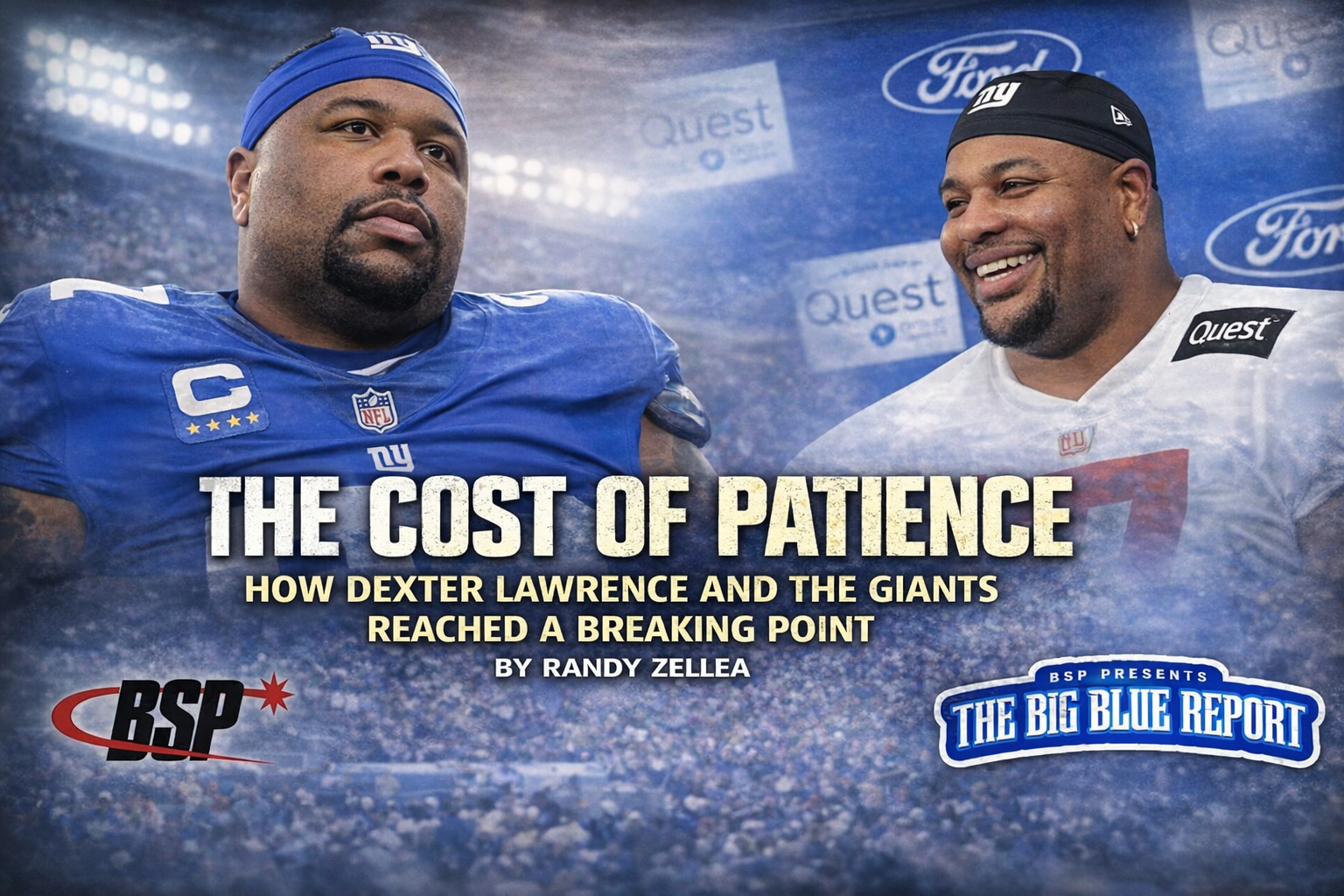
There is a certain weight that comes with being the player a franchise believes it can build around. The expectations are different. The responsibility is heavier. The patience required can feel endless. And sometimes, that patience quietly becomes the most difficult burden of all.
Dexter Lawrence did not arrive in East Rutherford with the noise that often accompanies a flashy skill position player. He was not a quarterback expected to save the franchise, nor a wide receiver destined to fill highlight reels on Sunday nights. He was something else entirely — a foundational piece, a player tasked with doing the difficult work that often goes unnoticed but is essential to everything else functioning properly.
When the New York Giants selected Lawrence in the first round of the 2019 NFL Draft, they envisioned a defender who could anchor the middle of their defensive line for the next decade. They envisioned consistency in a place where consistency had been difficult to find. They envisioned strength at the point of attack, leadership in the locker room, and the type of player who could quietly become indispensable.
But what neither the organization nor the player could have fully anticipated was just how much instability would surround that relationship over the next several seasons.
Lawrence entered the league with questions already attached to his name. Some evaluators had expressed concerns about the long-term durability of his surgically repaired ankle, which included titanium hardware. Interior defensive linemen are subjected to relentless physical stress, engaging in collisions on nearly every snap against players of similar size and strength. Durability matters at that position more than almost any other.
Still, the Giants believed Lawrence could be more than just available. They believed he could be impactful. They believed he could be reliable. They believed he could become one of the pillars of a defense that needed identity as much as it needed talent.
Early in his career, Lawrence showed flashes of that promise. He demonstrated the leverage, strength, and awareness that made him such a dominant presence at Clemson. He displayed the discipline required to occupy blockers, the physicality needed to stop the run, and the motor necessary to contribute in passing situations. He did not always fill the stat sheet in ways that captured national attention, but within the structure of the defense, his impact was evident.
What surrounded him, however, was constant change.
Since entering the league, Lawrence has experienced the type of organizational turnover that can test even the most committed player’s belief in long-term stability. Pat Shurmur’s tenure gave way to Joe Judge’s disciplinarian approach. Judge’s time eventually transitioned into Brian Daboll’s leadership. Mike Kafka briefly served as an interim guiding presence late in the 2025 season, and now John Harbaugh enters the picture as the latest voice tasked with restoring continuity to a franchise that has spent much of the past decade searching for footing.
Each coaching transition introduces a familiar request from leadership: buy in again. Learn a new system. Trust a new vision. Adjust to a new culture. Recommit to a process that promises better days ahead, even if those days feel perpetually just out of reach.
Rebuilding once can energize a locker room. Rebuilding repeatedly can slowly erode confidence, even among players who rarely express frustration publicly.
Lawrence has remained steady throughout these transitions. He has adapted to new schemes, embraced evolving responsibilities, and continued developing into one of the most disruptive interior defensive linemen in the National Football League. But consistency in performance does not always coincide with consistency in results, and the Giants have struggled to establish sustained success during Lawrence’s tenure.
Since 2019, postseason appearances have been limited. Momentum has been difficult to maintain. Promising stretches have often been followed by setbacks. For players expected to lead, losing seasons carry additional emotional weight. Leadership requires projecting confidence even when uncertainty exists. Leadership demands reinforcing belief even when progress appears incremental.
Over time, the distance between promise and results can become difficult to ignore.
Professional athletes rarely speak openly about the emotional impact of watching former teammates find success elsewhere, but the reality is unavoidable. Lawrence has seen players he shared a locker room with move on to different environments and achieve the ultimate validation in professional football: a championship.
Julian Love moved forward in his career and reached the sport’s summit. Leonard Williams did the same. Dalvin Tomlinson, affectionately known as “Nacho,” was not retained despite being part of the core defensive identity during earlier seasons. The names change, but the pattern becomes familiar. Players who endured rebuilding periods alongside Lawrence eventually found themselves in situations where winning became more consistent.
Seeing those outcomes inevitably invites reflection.
Competitors measure their careers not only by individual accolades, but by team success. They measure progress through postseason opportunities and championship contention. They evaluate whether the sacrifices required during difficult seasons ultimately lead to meaningful results.
Lawrence has done everything asked of him from a performance standpoint. Since 2022, he has established himself as one of the most productive interior defenders in football, consistently generating pressure on opposing quarterbacks while maintaining strong run defense presence. Interior pressure is among the most valuable defensive traits in the modern NFL. Edge rushers can influence pocket structure, but pressure up the middle disrupts timing immediately, forcing quarterbacks to make decisions sooner than planned.
Lawrence’s ability to collapse the pocket from the interior has become a defining element of the Giants defensive identity. He has faced double teams regularly, freeing teammates to create opportunities on the edges. He has demonstrated durability in a physically punishing role. He has improved as a pass rusher while maintaining the run-stopping presence that initially defined his reputation.
Production at that level inevitably leads to questions about compensation.
The defensive tackle market has evolved dramatically in recent seasons. Interior defenders capable of affecting both the run and the pass are no longer viewed as secondary pieces within defensive structures. They are considered essential components of championship-caliber units. Contracts awarded to players at the position increasingly reflect the value teams place on interior disruption.
Players understand where they rank relative to their peers. Agents monitor market trends carefully. When comparable players receive compensation that reflects elite performance, expectations adjust accordingly.
From Lawrence’s perspective, the argument is straightforward. His performance places him among the most impactful defensive tackles in the league. Elite impact warrants elite compensation.
From the Giants’ perspective, the calculation involves additional complexity. Salary cap management requires balance across multiple position groups. Long-term financial commitments influence roster flexibility. General managers must weigh individual excellence against the collective needs of the entire team.
Investing heavily at one position inevitably affects decisions elsewhere. Quarterback development, offensive line reinforcement, secondary depth, and skill position allocation all compete for financial resources. Even when a player’s performance justifies increased compensation, front offices must evaluate whether the timing aligns with broader roster construction strategy.
Leadership complicates these decisions further.
Lawrence is not simply a productive player. He is viewed as a stabilizing presence within the locker room. Leadership, however, often requires absorbing organizational tension quietly. Leaders are expected to represent continuity even when circumstances change. They are expected to project confidence even when uncertainty lingers.
Balancing leadership responsibilities with personal career evaluation can create internal conflict.
NFL careers are limited in duration. Prime performance windows can close quickly. Players must consider not only where they are today, but where their organizations appear to be headed.
From Lawrence’s vantage point, the current moment may feel like another reset. Another coaching transition. Another evolving roster. Another vision for future success that requires patience.
Patience, however, becomes more difficult with each passing season.
Professional athletes are rarely afforded the luxury of waiting indefinitely for circumstances to align. Careers are measured in seasons, not decades. Opportunities to compete at the highest level are finite.
The Giants may believe they are building toward sustained competitiveness. Lawrence may believe his prime years demand greater urgency.
Both perspectives can be valid simultaneously.
The challenge arises when timelines diverge.
Contract situations involving cornerstone players rarely remain contained indefinitely. When negotiations stall, narratives develop quickly. Questions about long-term commitment emerge. Speculation increases. External noise begins to influence internal dynamics.
Organizations entering transitional periods often seek alignment between leadership voices. Coaches want clarity regarding roster structure. Players want confidence in organizational direction. Front offices want flexibility to adjust strategy when necessary.
Unresolved situations involving respected leaders can complicate messaging within the locker room.
If separation ultimately becomes the most practical path forward, the Giants must consider not only the immediate return value but also the long-term competitive implications of where Lawrence lands. Within the NFC East, the presence of an elite defensive tackle can alter game plans significantly. Sending a foundational player to a division rival introduces variables that extend beyond a single season.
Strategic decisions must account for both present needs and future consequences.
Situations like this rarely produce clean resolutions. Extensions require compromise. Trades require evaluation of replacement strategies. Both outcomes introduce uncertainty.
What remains clear is that the current moment represents a significant juncture for both player and organization.
Lawrence has invested years in the Giants’ process. He has developed into one of the league’s most reliable interior defenders. He has embraced leadership responsibilities within a locker room searching for stability.
The Giants have invested in Lawrence’s development. They have relied on his consistency during transitional periods. They have benefited from his ability to perform at a high level despite surrounding change.
Both sides have demonstrated commitment.
Both sides now face difficult decisions.
Professional football often forces alignment between performance timelines and organizational direction. When those timelines match, continuity follows. When they diverge, change becomes possible.
Dexter Lawrence’s situation reflects the delicate balance between patience and progress. It highlights the tension that can develop when individual excellence intersects with organizational uncertainty.
Whatever decision ultimately emerges will shape not only the next chapter of Lawrence’s career, but the trajectory of the Giants franchise as well.
Because sometimes the most important questions facing an organization are not simply about talent.
They are about timing.
And whether patience remains a virtue — or becomes a cost too significant to ignore.

Featured Articles




Featured Writers


