Seven years.
That’s how long All Elite Wrestling has been in business.
When you stop and think about that number, it really isn’t that long. In the history of professional wrestling, seven years is barely a chapter. WWE has been around for decades. WCW lasted nearly 30 years. Even promotions that ultimately failed often survived longer than seven years.
Yet AEW has already experienced just about every growing pain imaginable. It launched with tremendous momentum in 2019 and immediately established itself as the biggest American wrestling alternative to WWE in generations. It attracted some of the most recognizable wrestlers in the world, created new stars, built a passionate fan base and secured major television partnerships.
Then the honeymoon ended.
AEW had to learn what every successful company eventually learns: having success creates a completely different set of problems. The roster grew, expectations grew, television commitments grew and the number of stories that needed to be told grew. Suddenly, the company that once had the luxury of being experimental had to figure out how to operate like a mature national wrestling promotion.
That’s where AEW’s story becomes fascinating. Seven years after its creation, AEW doesn’t look like a company desperately trying to prove that it belongs. It looks like a company that is beginning to understand exactly what it wants to be.
That doesn’t mean the company has avoided failure. It hasn’t. AEW’s history includes creative misfires, roster-management problems, backstage controversies, injuries, underwhelming signings and periods when the product lacked direction.
But it also includes genuine successes: the creation of a national alternative, the elevation of new stars, the revitalization of the tag-team division, the arrival of major international talent and the establishment of a workplace where many wrestlers believe they have another place to build their careers.
AEW’s story is not one of perfection. It is a story of trial and error.
THE FIRST AEW WAS BUILT ON POSSIBILITY
When AEW debuted, the excitement surrounding the company was about possibility. For years, fans had talked about wanting another major wrestling promotion in the United States. They wanted competition, alternatives for wrestlers and different styles of wrestling presented on a national platform.
AEW gave them that.
The company immediately positioned itself as something different. The Young Bucks, Kenny Omega and Cody Rhodes represented a new generation of wrestling personalities who believed they could build something outside of WWE, while Tony Khan provided the financial backing and business infrastructure necessary to make that vision possible.
Chris Jericho’s involvement gave the company credibility. Jon Moxley’s arrival demonstrated that established WWE stars could leave and immediately become major players somewhere else. Wrestlers from Japan, Mexico, the United Kingdom and other parts of the world suddenly had a national American platform.
AEW’s early success wasn’t an accident. The company understood what its audience wanted. It gave fans matches they weren’t seeing on WWE television, emphasized athletic competition, made the tag-team division important, embraced international wrestling and gave younger wrestlers opportunities.
The launch itself was a major success. AEW created immediate interest, sold out large venues, secured a national television deal and gave fans a reason to believe that American wrestling could support more than one major promotion.
But success also created expectations. Soon, every free agent became a potential AEW signing. Every WWE release became a discussion. Every wrestler who wasn’t being used properly somewhere else became somebody fans wanted Tony Khan to sign.
Eventually, AEW had to learn a difficult lesson: You can’t build a sustainable wrestling company by signing everybody.
THE ROSTER BECAME BOTH A STRENGTH AND A PROBLEM
There was a period when AEW’s biggest strength became one of its biggest weaknesses. The company had an incredible amount of talent, but there were only so many hours of television. That created a problem: a wrestler could be talented, over with the audience and capable of having a great match—and still disappear for weeks.
AEW had acquired so much talent that some wrestlers became victims of the company’s own success. This wasn’t necessarily a problem of bad wrestlers. It was a problem of roster management, and that’s an important distinction.
The company’s large roster gave AEW depth, but it also made the product difficult to organize. Some wrestlers were signed with little obvious direction. Others were introduced strongly and then cooled off. Several talented performers struggled to find consistent television time. In some cases, fans were left wondering why a wrestler had been signed at all.
That was one of AEW’s clearest failures. The company often treated talent acquisition as a victory in itself, even when there was no clear plan for what would happen afterward.
The lesson AEW appears to have learned is that a roster isn’t simply a collection of names. It’s a collection of roles. Who is your world champion? Who is your next world champion? Who can become a television attraction? Who can elevate somebody else? Who belongs in the tag-team division? Who needs more time to develop? Who can work with international talent? Who can become a crossover star?
Those are the questions a mature wrestling company has to answer, and AEW appears to be asking more of those questions now.
EVEN THE WRESTLERS ACKNOWLEDGE THE CHANGE
One of the most compelling parts of this story is that the people inside AEW are acknowledging that the company has changed.
Eddie Kingston, who joined AEW during the company’s early growth period, was asked whether AEW was still the same company he entered in 2020. His response was blunt:
“No, it’s changed. It’s definitely changed. The roster has changed. The office has changed, all that stuff.”
Kingston wasn’t necessarily trying to make a grand statement about AEW’s business strategy, but his observation carries weight because he lived through the company’s evolution. He saw the early AEW locker room and experienced what the company became as it expanded.
Perhaps that’s the simplest way to describe AEW today. It isn’t the same company, and it shouldn’t be. A company that looked exactly the same seven years later would probably be a company that wasn’t learning.
THE LOCKER ROOM MAY BE THE BIGGEST CHANGE
The perception of AEW’s backstage environment has also changed over the years. There was a period when backstage disagreements became major stories. Wrestlers had public issues with one another, executives were criticized for allowing problems to escalate and the company became associated with controversy that had nothing to do with what was happening inside the wrestling ring.
That was a problem.
The backstage incidents involving major AEW names damaged the company’s public image and distracted from the product. Instead of conversations focusing on matches, characters and storylines, AEW was often forced to answer questions about internal conflict.
Professional wrestling has always had backstage politics, but in the modern media environment, those disagreements can become part of the product whether the company wants them to or not. AEW’s failure was not simply that disagreements occurred. It was that the company sometimes appeared unprepared to manage them before they became public controversies.
That’s why Kyle Fletcher’s comments about the current AEW locker room are so significant.
Fletcher described a group where:
“Everyone backstage loves this place. Everyone is happy to be there.”
He also described the enthusiasm surrounding the company as “infectious,” explaining that wrestlers were excited to work together and wanted AEW to succeed.
That is an entirely different type of story. Instead of hearing about wrestlers fighting over their positions, you’re hearing about wrestlers wanting the company to succeed. That doesn’t mean every person backstage agrees on everything. No locker room does. But the perception of the environment matters, and AEW seems to understand that now.
A healthier locker room is not just good for morale. It is good for the product. Wrestlers who trust one another are more likely to collaborate, take creative risks and help elevate the people around them.
TONY KHAN HAS CHANGED TOO
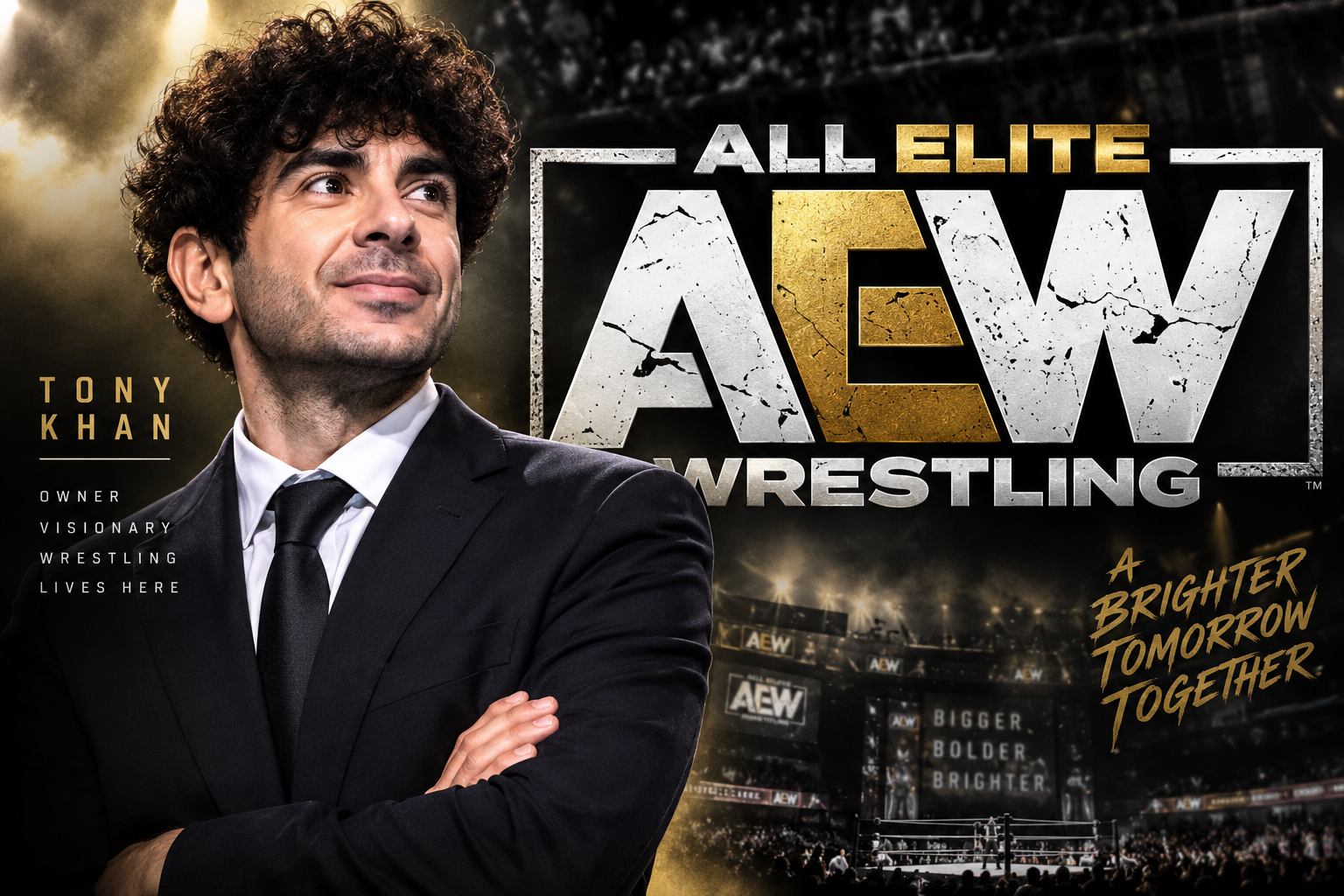
Perhaps the most important evolution has been Tony Khan himself.
Khan was a first-time wrestling promoter when AEW launched. He had studied the business and had tremendous passion for wrestling, but there is no substitute for actually running a national wrestling company. You learn by doing, making mistakes, signing somebody and discovering that the fit isn’t right, putting a storyline together and realizing it isn’t connecting, dealing with injuries and recognizing when a television segment doesn’t work.
You also learn when your roster becomes too large and when your biggest star becomes your biggest problem. Khan has experienced all of it.
Some of AEW’s failures have been connected directly to the company’s creative structure. Storylines have occasionally been changed or abandoned without enough explanation. Wrestlers have sometimes been pushed strongly one week and forgotten the next. Major angles have not always received the follow-up they needed.
Those problems are especially noticeable because AEW has often presented itself as a promotion built around creative freedom. Freedom can produce exciting results, but it also requires strong leadership and clear communication. Without that structure, a large roster can become difficult to manage.
Looking back at the end of 2024, Khan said he wanted to work harder and make 2025 AEW’s best possible year. His stated goal was to have AEW finish that year “in a better place than where we started.”
According to Khan, that’s exactly what happened.
That statement is important because Khan isn’t pretending AEW hasn’t made mistakes. He’s essentially saying that the company evaluated where it was, identified areas that needed improvement and attempted to correct them.
That’s what good organizations do. They don’t pretend the mistakes didn’t happen. They learn from them.
THE FREE-AGENT STRATEGY HAS MATURED
This may be where AEW’s evolution becomes most obvious.
AEW is still going to sign major wrestlers. It should. That’s part of what makes the company exciting. But there is a difference between signing a major wrestler because he’s available and signing a major wrestler because you already know how you can use him.
That’s the difference between acquisition and strategy.
Look at some of AEW’s biggest signings. Jon Moxley immediately became one of the company’s foundational stars. Chris Jericho brought instant credibility. Swerve Strickland evolved from an established wrestler into a legitimate AEW main-event star. Will Ospreay arrived with an international reputation and has become one of the company’s most important performers. Kazuchika Okada brought one of the most decorated careers in modern Japanese wrestling, while Mercedes Moné brought worldwide name recognition and elevated AEW’s women’s division.
Those signings weren’t simply about putting another recognizable person on television. They gave AEW different tools, and that’s what the company needs to continue doing.
However, AEW’s free-agent strategy has also produced failures. Some signings were announced with enormous fanfare but never received a meaningful storyline. Others were brought in without a clear role. A few wrestlers were positioned as major stars but never connected with the audience. Injuries also prevented several high-profile performers from reaching their expected potential.
The lesson is not that AEW should stop signing established talent. The lesson is that every signing needs a purpose.
WILL OSPREAY IS A PERFECT EXAMPLE
Ospreay’s comments about AEW are especially revealing.
When he arrived, he was already considered one of the best wrestlers in the world. AEW wasn’t creating Will Ospreay from scratch, but the company could provide him with a national American platform and opponents he hadn’t regularly worked with before.
Looking back on his time in AEW, Ospreay said:
“I didn’t realize the heights that I could reach here.”
He also said AEW had “completely changed my life.”
That’s significant. Ospreay didn’t arrive in AEW needing to become a star. He arrived as one. But AEW’s challenge was to take that established international star and make him an important part of the company’s own identity.
That’s very different from simply putting a famous wrestler on television and hoping fans care.
Ospreay represents one of AEW’s successes because the company has allowed him to remain distinct while also making him part of its main-event picture. His athletic style fits the promotion’s identity, but his presence also gives AEW a performer who can appeal to longtime wrestling fans and newer viewers.
SWERVE STRICKLAND AND THE IMPORTANCE OF DEVELOPMENT
Swerve Strickland may be an even better example of what AEW can accomplish when it gets things right.
Swerve arrived with a strong reputation, but he wasn’t necessarily viewed as an inevitable world champion. AEW gave him time to develop his character, find his voice, build his faction and become more comfortable as a main-event performer.
Eventually, AEW turned Swerve into a world champion.
That’s the kind of success AEW needs more of. Signing stars is easy. Creating stars is much harder. AEW has demonstrated that it can do both.
Swerve’s rise also showed the value of patience. His success did not happen overnight. It came through a series of character developments, rivalries and performances that gradually changed how the audience viewed him.
That is one of AEW’s greatest accomplishments. The company has not simply imported stars from elsewhere. It has helped create stars who feel connected to AEW.
THE TAG-TEAM DIVISION WAS AN EARLY SUCCESS
Another major AEW success was the company’s early commitment to tag-team wrestling.
The Young Bucks, Lucha Brothers, FTR, Jurassic Express, Private Party and other teams were treated as important parts of the product. Tag-team matches were given time, rivalries were built around championships and the division often felt like more than a collection of wrestlers waiting to become singles competitors.
That helped AEW distinguish itself from WWE, where tag-team wrestling had often struggled for consistent importance.
The division has not always remained equally strong. Injuries, departures and inconsistent booking have affected its momentum. But AEW proved that a national wrestling audience would invest in tag-team wrestling when the teams were presented as meaningful acts.
That was a clear success, even if maintaining that success has been more difficult.
THE WOMEN’S DIVISION HAS SHOWN BOTH PROGRESS AND FRUSTRATION
AEW’s women’s division is another area where the company has experienced both success and failure.
The promotion has featured talented performers such as Britt Baker, Thunder Rosa, Hikaru Shida, Toni Storm, Jamie Hayter, Willow Nightingale, Kris Statlander and Mercedes Moné. Several wrestlers have become major stars, and the division has produced memorable matches and characters.
Toni Storm’s transformation into “Timeless” Toni Storm was one of AEW’s most successful character developments. The gimmick gave Storm a distinct identity, allowed her personality to shine and created a character that felt different from what other major wrestling promotions were presenting.
At the same time, AEW has often been criticized for inconsistent television time for its women’s division. Storylines have sometimes received less attention than the men’s programs, and talented wrestlers have occasionally disappeared from television.
That inconsistency represents a failure of presentation rather than a lack of talent. AEW has the performers necessary to build a strong women’s division. The challenge is giving them the time, structure and long-term planning required to make the division feel equally important.
THE BIGGEST LESSON: NOT EVERY SIGNING WORKS
Of course, no honest AEW story can pretend every major signing worked. They didn’t.
Some wrestlers arrived with enormous expectations and never reached them. Others were affected by injuries. Some didn’t fit the creative direction, while others simply didn’t connect with the AEW audience in the way the company hoped.
That’s professional wrestling. Not every signing becomes a success. The important thing is whether the company learns from those experiences.
AEW’s early years sometimes gave the impression that a major name had to be signed simply because WWE had that name. Today’s AEW seems more willing to ask another question:
What does this person actually add to AEW?
That’s growth.
A failed signing does not automatically mean the decision to hire someone was wrong. Sometimes the wrestler gets injured. Sometimes the audience rejects the character. Sometimes the creative plan changes. But repeated failures without adjustment become a pattern.
AEW’s challenge is to make sure its mistakes become lessons rather than habits.
AEW DOESN’T HAVE TO BE WWE
Perhaps the biggest lesson of all is that AEW doesn’t have to beat WWE by becoming WWE. It has to succeed by being AEW.
That’s what made the company interesting in the first place. AEW can feature long-form wrestling matches, showcase international wrestlers, make the tag-team division meaningful, experiment with presentation, give wrestlers more creative freedom and introduce fans to wrestlers they may not have seen before.
It can also continue creating an environment where wrestlers believe they have another legitimate place to build their careers.
Bryan Danielson has argued that AEW’s existence changed the wrestling landscape because wrestlers now have greater leverage and another major destination. That’s bigger than television ratings. That’s an industry impact.
Before AEW, WWE essentially operated without a comparable national American competitor. Now it doesn’t. That alone changed the business.
SEVEN YEARS LATER, AEW HAS SOMETHING IT DIDN’T HAVE IN 2019: EXPERIENCE
This might ultimately be AEW’s greatest advantage: experience.
Tony Khan has seven years of experience running the company. The wrestlers have seven years of experience working within the AEW system. The production team has seven years of experience producing AEW television. The audience has seven years of experience understanding what AEW is.
The company also has seven years of data telling it what works and what doesn’t.
That’s something you can’t buy. You have to earn it, and AEW has earned it.
The failures matter because they provide context for the successes. AEW knows what happens when the roster becomes too large. It knows how damaging backstage controversy can be. It knows that a major signing needs a plan. It knows that a promising storyline needs follow-up. It knows that creating stars requires more than simply putting talented wrestlers on television.
Those lessons can make the company stronger if they are applied consistently.
THE NEXT CHAPTER
There is still work to do. AEW still has to consistently create new stars, manage its roster, maintain creative consistency and compete for viewers in an increasingly crowded entertainment landscape.
But that’s different from the existential questions surrounding the company during its rougher periods. AEW isn’t trying to prove that it can survive its first year anymore. It’s trying to establish what the company will look like in year 10, year 15 and beyond.
That is why the next stage of AEW could be its most interesting.
The first seven years were about experimentation, building a roster, establishing a television product and learning what works. They were also about discovering what doesn’t work: signing too many wrestlers, allowing stories to lose momentum, failing to use the roster efficiently and allowing internal problems to overshadow the product.
The next seven years should be about refinement: taking the lessons, keeping the things that worked, eliminating the things that didn’t, developing young wrestlers and using established stars to elevate them.
When the next major free agent becomes available, AEW shouldn’t ask simply:
“Can we sign them?”
It should ask:
“Can we make AEW better by signing them?”
That’s the difference between a company chasing talent and a company building a promotion.
Seven years into its existence, AEW may finally be making that transition. It isn’t perfect, and it never will be. But perhaps that’s the point. AEW doesn’t need to be perfect. It needs to keep getting better.
Its successes prove that the company can create stars, deliver major matches, provide meaningful competition and change the wrestling industry. Its failures show that ambition without structure can create problems just as quickly as it creates opportunities.
If the comments coming from the wrestlers and Tony Khan are any indication, the company believes it is doing exactly that.
Seven years ago, AEW was the new kid on the block. Today, it’s an established part of the professional wrestling landscape. Perhaps the biggest surprise isn’t that AEW made it seven years. It’s that after everything the company has experienced, the best version of AEW may still be ahead.

Featured Articles




Featured Writers